By Pat Gere
Dave McGinn’s Globe and Mail opinion piece published May 11, “Study warns violence in Ontario schools is at ‘crisis levels’ for teachers and education workers,” is dire. The article discusses studies done on violence in Ontario schools, particularly a new report by researchers from the University of Ottawa released last month – ‘Running on Fumes: Violence, Austerity, and Institutional Neglect in Ontario Schools.’ Violence in schools is continuing to increase and the study outlines a number of causes: underfunding, overcrowded classrooms, increasing student needs, lack of supports, as well as food insecurity.
Professor Bruckert, a criminology professor and one of the study’s authors is quoted: “It‘s really important not to see this as bad kids or demonize kids. This is truly structural violence. This is institutional violence. This is a failure to respond to needs that ends up being enacted like violence,” Prof. Bruckert says.
I want to focus here on the role of the institution, the role of its structure.

Our current education system was developed with the premise that you had to reward or coerce learners to get them to apply themselves. Most of us clearly remember the impact of grades and as late as the 1980’s corporal punishment was still administered in schools in Canada and remains a ‘motivator’ in many parts of the world to this day.
The carrot and stick are necessary when the system requires learners to follow directions, follow schedules, eat when you’re told to, read when you’re told to, write or do math when you’re told to, learn particular information when you’re told to, or put something interesting down even if you’re not finished with it. Strict discipline was and is necessary for an educational method that goes against the natural inclinations of children and youth, and in fact, against the inclinations of humans in general.
Today we have the same education system but we don’t use punishments. I’m not suggesting that we should punish, but without the ability to enforce strict discipline this system of education is doomed. One indication is the violence we see growing in schools. Students acting out, confronting authority without significant consequences, failing to learn or to thrive, and impacting the learning of classmates.
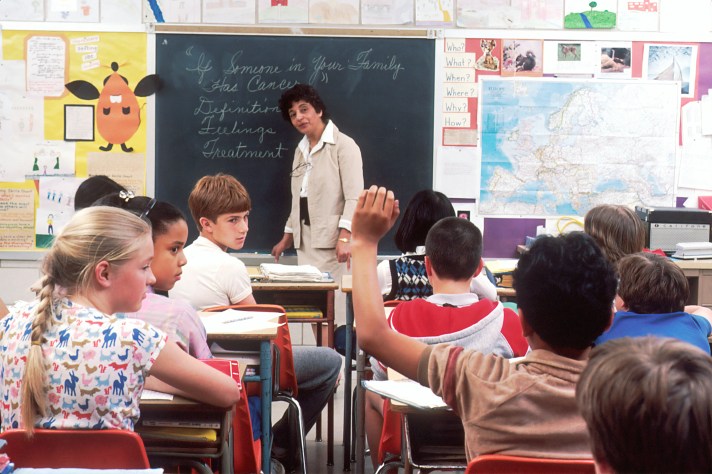
Imagine yourself following the routine of a Grade 6’er. You’re sitting in a large class for long periods, studying subjects that don’t have immediate relevance. There’s one teacher to manage everyone and it’s easy to hide, ignore, needle, confront or outright refuse an instruction. If you have difficulty in a subject, you’ll still be moved ahead from grade to grade without the support to manage the higher-level work, thus placing you in situations where you cannot possibly succeed. After being in school from 9 AM to 3:30PM, you are sent home with more work to do. If your parents have time or financial resources they can try to assist you or get you a tutor. You still must work overtime in order to succeed.
Even as an adult, could you manage this day after day? Would you be willing to? Could you be successful in this type of environment? Could you learn? Would you be willing to supervise much less try to teach in this environment?
One response to managing without using punishments has been to increase the entertainment quotient of what is being offered. Find the most engaging video. Find the most enticing online game. But this approach has its own challenges. It is not an efficient way to learn as the entertainment is primary, the educational concept secondary. It doesn’t support creativity, compassion for others, or agency, the willingness and desire to act. And given that today’s youth spend most of their time being entertained, including through social media, it is hard to compete.
There are other ways to educate. They can be difficult for us to consider because the current institution is so pervasive. It’s hard to imagine there is anything else … but there is.
There are education models that take as their basis our natural human tendencies to move, explore, orient, organize, communicate, and connect. All humans are born with these tendencies. You’ve seen them in young children. The infant reaching for a coloured object or surprised by rolling over; a young child attempting to crawl, mimicking speech, taking that first step. We are hard-wired to explore and master our world and we can use this to create learning environments based on these innate characteristics rather than on external carrots and sticks, or entertainment.
This type of education model is often referred to as learner-centered and it’s a growing movement. One type of learner-centered education that has been around for a long time, spread globally, and has research to support its efficacy, and the one I know best, is Montessori. Let me describe it briefly to give you an idea of what else is possible.
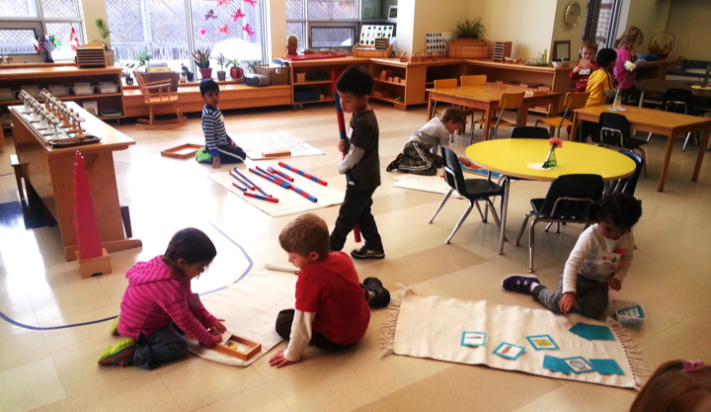
In a Montessori classroom, a series of activities covering all aspects of the curriculum are arraigned on shelves accessible to the learners. The activities are specifically designed to appeal to the characteristics of that age and provide for movement, exploration, precision, and increasing competency. In a Montessori environment the adult acts as a guide, introducing an individual learner or a small group of learners to an activity that the guide believes will be of interest. The guide demonstrates how to use the activity but leaves the learners free to interact with it themselves. By observing the learner’s activity, the guide can gauge the learner’s interest, focus, and growing understanding of the underlying concept. What is right for one learner won’t be the right choice for another so in a Montessori classroom, learners are busy with many different activities. Learners work independently, driven by their innate human characteristics rather than by external rewards or punishments. The goal of the guide is finding the right intersection of the knowledge or skill to be learned and an individual’s need and passion. When a learner is engaged in this way, they are very focused, learn easily, persevere, don’t tire, are energized and feel good about themselves, a state described by Dr. Csikszentmihalyi as flow. There really is no downside. When you feel accomplished and satisfied, you are willing to contribute rather than disrupt, to help rather than hinder.
Montessori is one example of a learner-centered ecosystem. There are others and it’s past time to seriously consider a revolution in the institution of education. For our children’s sake, and for the world’s.