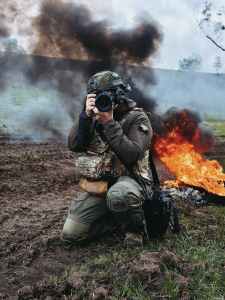
With the uncertainty in the world seen every day in the news, I find myself continually asking, “What can I do? What should I do?” I don’t want to be turning a blind eye if there is something I can contribute to make the world a safer place, a kinder place. One opportunity that presented itself was to take an online course offered by an international organization, World Beyond War, on ‘Unarmed Civilian Defense’. A major premise of this course is that unarmed civilian actions are just as, or more, effective in responding to aggression as armed resistance is, and with less loss of life and property, and less environmental damage. There are countries in the world that rely successfully on this concept and many historical and contemporary instances of its efficacy. One has only to look at Minnesota’s response to ICE for an example. It should be in the arsenal of every country because every citizen, including me, a senior, can contribute.
One requirement for the successful use of Unarmed Civilian Defense is engaged citizenry. While we can wait until citizens feel they have no choice but to arise and respond such as when threatened by invasion, how much more effective it would be to have engaged citizens who recognize their responsibility and their power before a threat necessitates it. This means we must nurture citizens who are not apathetic or complacent, citizens who feel a strong sense of responsibility for their community/nation/world, and who believe that their contribution can make a difference, a difference significant enough that they are engaged and prepared to act. A citizenry that believes in their agency, individually and as communities.
This is not the case for many Canadians. Many of us feel that our actions will not make a difference. (Just look at how few of us vote!) We don’t raise citizens who feel that they can make a difference even if they try or that they have the responsibility to do so, but we could.
We can change the way we educate our young. We can move away from the current model that encourages and rewards doing what you are told, when you are told and gives the responsibility for what an individual does and learns to an external authority, the teacher. But neither should we let the pendulum swing to a model where every student does their own thing without any regard for community. We need a system that models what we want to see in an engaged, responsible citizenry. We need a system based on communities of diverse learners, of more than one age/grade/ability, who stay together long enough to form a community responsible for maintaining itself and capable of doing so, where members learn not only academics but who they are – their strengths and challenges – and what they can best offer their community and why it matters. Where learning how to manage differences and conflicts is a natural part of every day. Where stepping up and being responsible is just the way it is.
This is not as unrealistic as it may sound to the many who have never experienced anything but our current education model. I know one example of such an education system well: Montessori. In high fidelity Montessori classes (I use ‘high fidelity’ because the label Montessori is not protected and as it gains in popularity, its name but not its substance is ‘borrowed’ for commercial purposes), in high fidelity Montessori classes, there are children/students of three different ages/grades, classes where each student stays for three years. There are activities on shelves around the room that cover all the academics, as well as equipment for caring for the environment and one another, everything from brooms and mops and buckets to table settings and cooking and dish washing equipment.
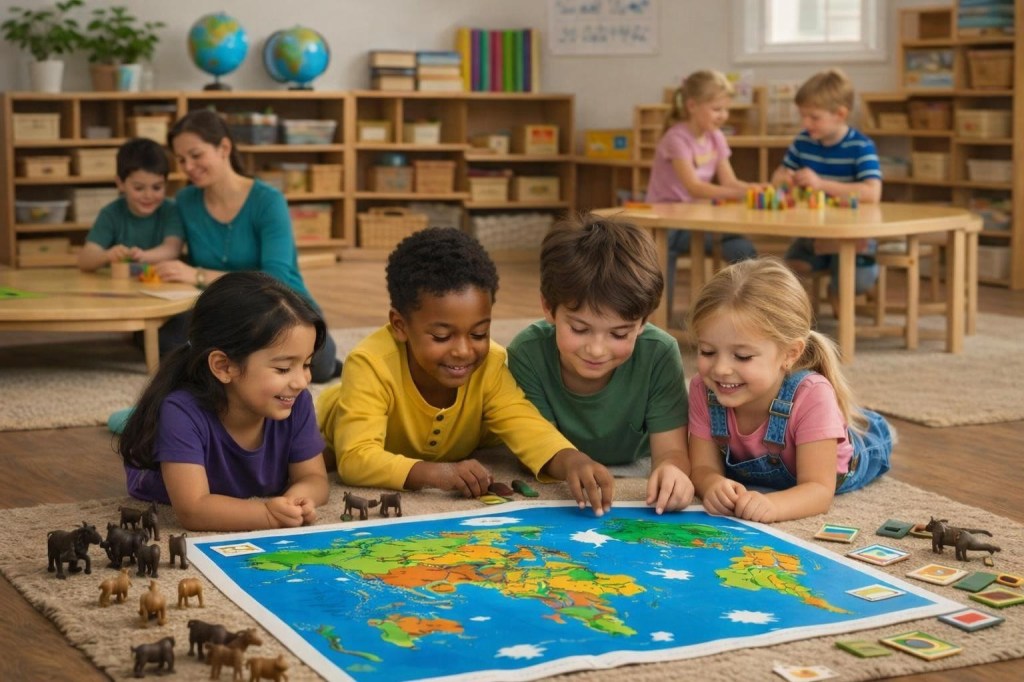
The adult is called a guide because they demonstrate to small groups of students the use of the materials and the inherent ideas. The students’ use of the materials or ideas ‘teaches’ the concept. The students use their initiative and their understanding of what they need, to choose what they are going to do and when they are going to do it. Students get help from, and offer help to, one another. The guide provides each student with the specific direction and assistance they need but no more. If a student has difficulty choosing appropriately the guide helps by giving direction that is specific to that individual. What develops is a community of learners where each individual is known for who they are; where everyone is on a journey, always with something new to learn academically, personally, and socially, as well as something new to offer. Balancing personal and community needs, decision making, taking responsibility, conflict resolution and peace making form a natural part of everyday life.
Another action to grow a more engaged citizenry, with more immediate results, would be to support programs such as Katimavik and the YMCA youth work and travel exchanges. Education outside the classroom is often life-changing, especially for young adults.
Katimavik Canada offers young people the opportunity to learn and work in different communities in Canada, increasing independence, knowledge of different ways and beliefs, and trust in relying on others. In November 2025, Katimavik Canada asked the Canadian government to use the already existing Katimavik program to launch a mandated national Youth Climate Corps.
Their website details the impressive impact of their ‘National Experience’ programme:
“Through Katimavik’s National Experience, participants contribute about 30 hours per week to projects across the country, advancing climate resilience, food security, environmental restoration, and emergency readiness, while gaining job-ready skills.”
“The results:
• 96% improve leadership skills
• 94% strengthen personal resiliency
• 90% build cross-cultural competence
• 88% improve teamwork
• 84% increase civic engagement”
A Youth Climate Corps would develop engaged citizenry.
We Canadians are hearing clearly that we are no longer as secure in the world as we thought we were. While our government is increasing our military strength and securing partnerships with other middle powers, we should also be nurturing an engaged citizenry. Armed forces will never be enough on their own for a middle-power country like Canada. An engaged and responsive citizenry is a must-have, and educational experiences are one key.

What are your thoughts?