Empowering Youth with AI: A New Educational Paradigm

I’ve been pondering Artificial Intelligence, AI, along with just about everyone else in the world and mostly coming up with negative, doomsday scenarios. But this morning, I found the nudge into a more positive place that knit together what I know from my experience schooling youth in an alternative system, my grandchildren’s recent camping trip to the wilds of Algonquin, and the article I read about an afterschool program for youth, the Youth Climate Action Leadership Series.

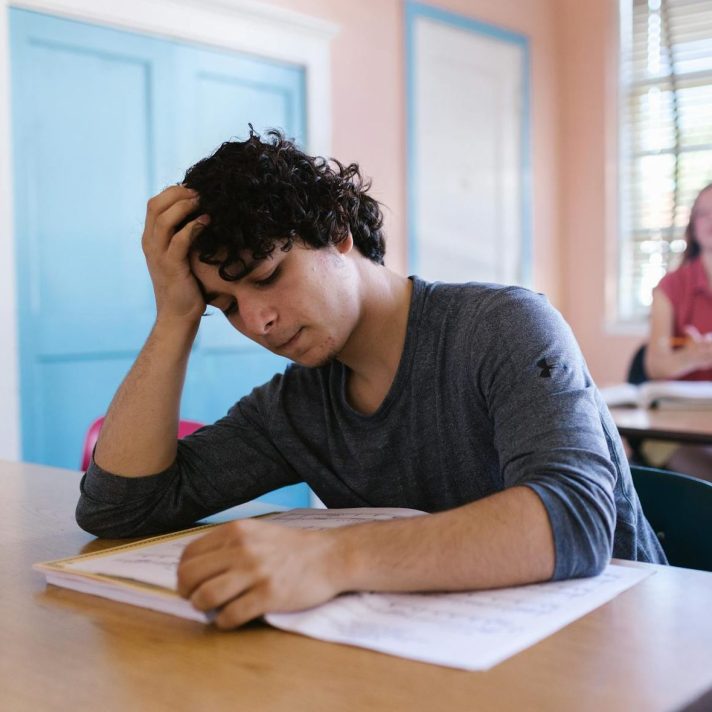
Photo by Laura Stanley on Pexels.com

In the age of AI what do youth need, what do they crave that would make putting effort into learning worthwhile? For some youth, the situation they’ve grown up in or that their parents grew up in clearly indicates to them that they need not onlly academic credentials but also the ‘how to’ to be successful and provide for themselves and their families. And so, they put the attention and effort into truly learning. But for many youth an academic education isn’t a priority, maybe the marks but not the actual learning They attend school because it is expected. They have to.

Developmentally, genetically, adolescents are primed for action, for risk, for learning by doing – just when we confine them to seats in a classroom and prescribe their activities. Ask most high school students about their day and the majority will tell you about anything but their classes. You’ll hear about their friends, what’s happened on social media, how well they’re doing in an online game, perhaps about football or band practice or auditions for the musical – anything and everything but their classes.

In the article about the Youth Climate Action Leadership Series in the Community Foundation of Greater Peterborough’s summer newsletter (the third article), we find one of the keys to what engaged, adolescent education could be.  In this programme youth aged 13 to 18 were invited to co-create and lead hands-on workshops on climate action.

“They’re not only working on eco-friendly craft projects while connecting with peers and community members. These young people were given real decision-making power, including how to allocate actual funds to projects that mattered to them.” And that is the key – real decision-making power – agency.

Quotes from the article show the importance and the impact:

“… the real reward was learning how to lead. Not by telling others what to do, but by collaborating.”

“Helping others boosts your sense of self… You can’t get that if you don’t go outside and pitch in.”

“[People] always say that the youth is the future, and here we are, trying to do good and help others. We just need help with it. That’s all we really need. Just more money and support so we can keep doing this.”

“By learning how to mend clothes, reduce waste, and repair electronics, these youth are doing more than gaining practical skills. They are quietly repairing something harder to measure: the frayed threads between generations, between community and climate, between the future they’re inheriting and the world they’re determined to create.”

This is what adolescent education should be.

My grandchildren’s wilderness camping trip had agency and another important component – risk. While my daughter-in-law and the children’s aunt were the responsible adults, everyone needed to work together and contribute. There was no cell service. Each day began with breakfast and group decisions about what they would do and where they would go. Meals to make and tidy up, dishes to be done, fires to be built, canoes to be paddled and portaged. And when I asked them if they were happy to be returning home – no – they would readily have stayed longer. They have camped together for a week each summer for at least 10 years and the other component that has kept them coming back is risk – opportunities to choose to test themselves. Hikes of unknown length and difficulty to spectacular views, cliff jumping into pristine waters, searching for and catching water snakes, surfing rapids, portaging a canoe. “I did it!” Just as the toddler revels in taking their first steps, youth crave testing their limits and discovering they are more than capable.

For these reasons, Montessori adolescent programs are organized around such authentic life experiences, originally, and still in some schools, specifically by residing on a farm where all its necessary, real chores and life decisions are placed as fully as possible in the adolescents’ care. The adults act as mentors, coaches and teachers. Academics are linked to the day-to-day requirements of providing for themselves and the farm.

Photo by Zen Chung on Pexels.com

Urban Montessori adolescent programs strive to provide similar experiences of adolescent ownership and responsibility with wilderness trips; work with and for urban organizations like community gardens; and micro-economies – small businesses designed, run and managed by the youth themselves that incorporate the basic concepts of production and exchange. In these urban activities, the adults must exert more self-control so as not to take on responsibilities themselves but rather set up circumstances that place the responsibility and outcomes on the adolescents – succeed or not. On a farm, everyone must work together or the consequences are very real – an animal is in discomfort or the main dinner dish is not ready on time. In urban environments it is much more challenging to place the responsibility on the adolescents, but this is key.

Adolescents are innately designed to be doing and managing and when given the responsibility they not only rise to the task but feel good about themselves and their ability to make authentic contributions.  

What does this have to do with Artificial Intelligence? What if schooling set our adolescents to work on the problems of our world? AI could track what each is learning academically as they do this and what each hasn’t yet covered. Perhaps AI could provide lessons individualized and connected to what is currently engaging them. High school buildings could become multi-age community hubs, resource-rich meeting and workspaces – those important third places that our communities are losing, and who knows, new high schools might even have a less penitentiary-like design. Teachers would be mentors, coaches and resources. Imagine having students who want to learn, who want to be involved, who choose to use AI as a tool.

I hope AI will push schooling over the edge into something more compatible with human development, and more useful, exciting, productive, and positive for youth and the world.  Given that AI can answer most assigned questions, do research, and complete fully cited essays, we have little choice but to adopt another method of education, another paradigm – a paradigm that capitalizes on the real world and its problems, and includes agency and risk in community with adults who are primed to walk with rather than lecture and direct. It is possible. Yes – it is challenging to change the direction of something as imbedded as our current schooling paradigm but maybe, with an assist and a nudge from AI, it’s possible. Let’s try and see what we’re capable of!

P.S. If you need an assist into feeling more hopeful generally, I highly recommend reading the first article in the Community Foundation of Greater Peterborough’s summer newsletter.

AI, Curriculum, and a Much Loved Children’s Encyclopedia

What young learners need in a world of AI

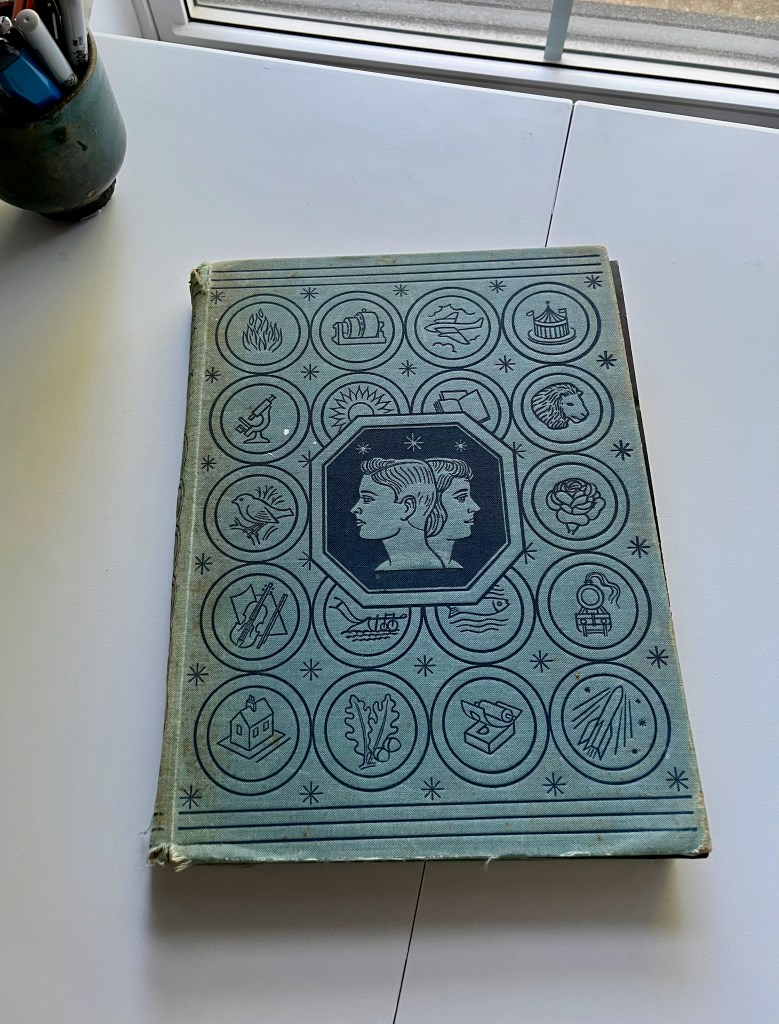
There’s a lot out there about AI these days. You can’t peruse any education feed or even scan a news site without running into it. I was pondering what AI can’t give us. And that led to a post on the importance of concrete, hands-on materials for younger children. The younger they are the more imperative activities that involve the hand, movement and the senses as well as the mind. Then thoughts about curriculum. What kind of curriculum do we need in this age of AI and at what age? I think most believe we still need to teach “reading, ‘riting and ‘rithmetic,” but what about all the other information based curriculum? What do learners need in order to understand history, science, the arts – the information about our world and how we got to where we are? And with that, my mind puzzlingly skipped to a longing for a dusky blue, cloth covered, heavy tome – Odham’s Encyclopedia for Children. 

Odham’s Children’s Encyclopedia

First curriculum – I, along with many others, have fallen in love with the Montessori Elementary curriculum. The first year in a Montessori Elementary class begins with the oral telling of the sweeping story of our universe and our world from the Big Bang through the formation of stars, the happenstance of our solar system, the just rightness of the conditions on Earth, the incremental changes that brought life – single cell organisms, plants, animals and finally us, humans. This story clearly illustrates how everything is connected to everything else, to the past and to what will come. The story is told dramatically, with props, activities and illustrations. There are follow-up activities that sit on the shelves of the classroom for students to use independently to further their exploration. This story is told at the beginning of every school year, Grades One through Six, developing in complexity. It provides a framework into which all other knowledge links and is given meaning.

What has that got to do with an old (and I will definitely age myself here) well-used, and loved, children’s encyclopedia. I was surprised when, as I pondered curriculum, it came to mind, especially with the emotional resonance it brought. I had moved across the province about a year ago and had carefully culled my books because books are heavy and cost a lot to move. When I thought I had left this book behind – donated it to a Goodwill store? Gave it to my son for my grandchildren to possibly use as he had? – I was bereft. It surprised me. Why did it matter that I couldn’t lay my hands on this book? I thought about what was in it and considered, for the first time, why it mattered, what it had meant to me.

First came some images – a blue line drawing of a castle spread across two pages with the keep cut away, parts labelled. Then a full colour page of flowers done in watercolour. This encyclopedia was rich with drawings and text. No photographs, mostly black and white or monochrome drawings with some full pages in colour. It was published by a British press in 1957-58. I probably received it when I was 8 and in Grade 3. I think its significance was that it was my window to the world, past and present. I was the oldest of 5, eventually 7, children in a working class, suburban family where there was always something to eat for every meal but not much extra. Neither of my parents had more than some high school; both were of British immigrant families finding their way. We didn’t travel much, certainly not outside of Ontario, or mingle with those who did. A pretty circumscribed upbringing, except for this book.

I found it tucked at the end of one of my bookcases. I had followed my heart and brought it along. In addition to delighting in the many images I had forgotten were there, particularly the continent maps with their illustrations of fauna and raw materials, and a full page of flags of the world, I took a more detailed, nuanced look, reading the editors’ notes for the first time.

This is an encyclopedia, a sort of Aladdin’s cave stuffed, not with jewels, but with facts, more marvelous than jewels and often no less precious. It is a book of knowledge – knowledge of ourselves and our history; of the universe and the world in which we live; knowledge of flowers and animals; of the things we do and use; of science and invention; of the arts; of what is familiar, and what is strange and distant.

Most encyclopedias rely mainly on words to convey knowledge. But this is an encyclopedia in which words and pictures are of almost equal importance. The result is an absorbing display. The world and its wonders become the show of shows.

Yet the display is systematic. The book does not dart from one subject to another so filling your mind with odd scraps of information but deals with each group of allied things often showing in its detailed arrangement how one thing is linked to another. So you can either read it section by section or browse in it, reading here and there as you please.

And here is the thing – I was still being pulled into the content. Even now as I write this with Odham’s beside me, I find myself first slipping through the illustrations and then stopping to read a paragraph about the Romans and soon I was reading through the Middle Ages, Dark Ages, Renaissance and into the Modern Age. The power of this book remains. Why?

It tells a story – with pictures and words. Like any great story it leads you on and in – What happened next? Why? “The world and its wonders become the show of shows.” Knowledge-wise it provides a simplified framework of linked information, enough to whet the appetite for more. It doesn’t provide all the answers. It’s like an open hill in the middle of a countryside. You can see the paths and where they lead and choose which one you want to explore. You can always come back to the hill to see where else you might want to go. A place for curiosity to begin its journey.

What led me from musing about curriculum to an old encyclopedia? Both were windows to the world, a world often beyond my experience. Both provided frameworks that organized how things were connected through time and with one another. Both provided some information – a Goldilocks approach – not too much, not too little, just the right amount. Both were always available – the encyclopedia always present physically (even now) and the curriculum available through the memories created by repetition and the availability of the follow-up activities. Both were rich in words and images, words and images that, again, didn’t tell it all but invited further exploration.

Maybe this is what children need in the age of AI – a physical book, a weighty tome, with just the right amount of information in words and images. One sitting waiting when they are ‘bored’ and they’ve run out of ‘screen time,’ or (better) haven’t been allowed any because we’ve become much more circumspect about allowing young children access to screens and AI access to our children. Maybe this is supplemented by learner-centred schooling that provides a framework approach to knowledge, a framework that opens the world and its wonders for exploration. What path will a child take from these hilltops of curiosity?

Did you have a hilltop like the encyclopedia or the curriculum? What inspired your curiosity? What helped you organize the world and its wonders? I’d love to know, especially from those of you with the view of a different generation than my own. Thanks in advance for your response.

Using the Hand to Optimize the Mind

Concrete materials instead of screens, worksheets or textbooks

Concrete, well-made, open-ended materials that require manipulation have so much more to offer education than textbooks, worksheets, screens or apps, especially in a world with AI. And the younger the student the more imperative their use.

Here’s an example:

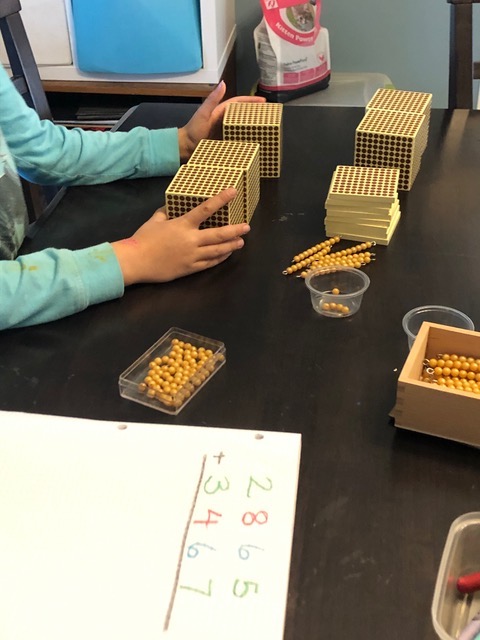
This material is called the Golden Beads. It has unit or one beads, ten bars, hundred squares and thousand cubes, and cards to go with each hierarchy. If you have an elementary-aged child, you’ve probably seen drawings of these on worksheets or in a textbook, but we should provide the material instead of the illustration. Here’s why:

Photo by P Gere

A concrete material-

  • Requires movement both large – getting the materials to a mat on the floor where you are going to work, and small – manipulating and organizing the components. (As modern humans we’re often enjoined to move more and so should our children.)
  • Combines not only the visual and auditory senses (seeing something and being told the name) but also the physical sense of dimension – how small, large, long, flat, etc.) and the baric sense (the sense of weight)
  • Provides the opportunity for working together – cooperating, negotiating, delegating, and sharing information
  • Is reusable rather than consumable
  • Is shared – requiring taking turns, as well as care and a return to its place so that others may use it (Think beyond the classroom to the reinforcement of ‘Reduce. Reuse. Recycle.’)
  • Flexible – can be used for multiple lessons – learning hierarchies and relationships, adding, subtracting, multiplying and dividing, borrowing and carrying
  • Obvious – students can see the material on a shelf and be reminded that they can work with it
  • Open-ended – students can create their own problems to work on. Young elementary students particularly enjoy ‘big’ things, the bigger the better. They can set themselves as large a problem as they want and have the immense satisfaction of solving it ‘Myself!’ At an age when repetition is not highly sought, doing huge problems provides the repetition necessary for consolidation of a concept without requiring an overseer.
  • Exploratory – “What happens if each of the three of us take out a quantity of beads without showing the others? Can we figure out who took out the largest number? How much did we take out altogether? How much did we leave on the shelf? How much does our class have when all the material is back in its place?”
  • Incremental – One concept leads to another. Learning to count and exchange categories/hierarchies to find how much you have in total before learning to add, learning to add the same addends leading to the concept of multiplication
  • Flexible – the speed with which new concepts are introduced can be easily adapted to each student as well as adapting the size or complexity of the problems tackled
  • Observable – the teacher can observe students using the material and, without interfering in any way, ascertain whether the concept has been mastered or not, and whether additional instruction is warranted – continuous assessment without tests
  • Independent – once a lesson has been given on how to use the beads for a certain task – say adding several quantities of beads together, students can work independently 
  • More likely to create flow or focused engagement – since an adult is not needed and students are having their needs for independence, movement, socializing and success met as they work, they are more likely to achieve the stage of focused engagement/flow where learning is the most efficient and effort results in renewed energy and feelings of worth and joy.

Why don’t we use concrete materials?

Why don’t we gift our students with multi-sensory, movement-required and thought-required materials that have such open-ended possibilities? It is true that successful use of materials requires a learning environment conducive to student engagement and opportunities for choice. Shouldn’t we be guiding students in making good choices as a life skill? Shouldn’t we be giving students ‘flow’ experiences so that they know the deep joy of engaged activity as an alternative to the addictive, short-lived high of being entertained, even if the entertainment is educational. Shouldn’t we be encouraging the ability to work together?

In addition to a learning environment that provides for using concrete materials, the materials have to be carefully designed in order to be optimally productive. A material should Isolate a concept but be open-ended. The only difference in these beads is how they are arranged – as single, ‘one’ or ‘unit’ beads, in a bar of ten, a square of a hundred or the cube of the thousand. There are no distractions such as cute pictures of animals, flowers or cars, only the beads. The material should be durable and beautiful and be of a size that best fits the students who will use it. Originally these beads were made of glass. Now almost all are plastic but hopefully plastic that has enough weight to give the physical sensation of the difference between the hierarchies. Practical – It isn’t practical to have hundreds and thousands made with beads, so after the concept is introduced most of the hundreds and thousands are wooden representations of the squares and cubes. The material should also be part of a continuum – before the Golden Beads a child would use a number of materials to be introduced to and consolidate the quantities and numerals 1 to 10.  After the Golden Beads the learner could use a material that represents the hierarchies with stamps that are the same size but are different colours to represent the different hierarchies, gradually moving the student from the concrete to the abstract. It’s important to see each material as related to what comes before and after, as well as to other disciplines.

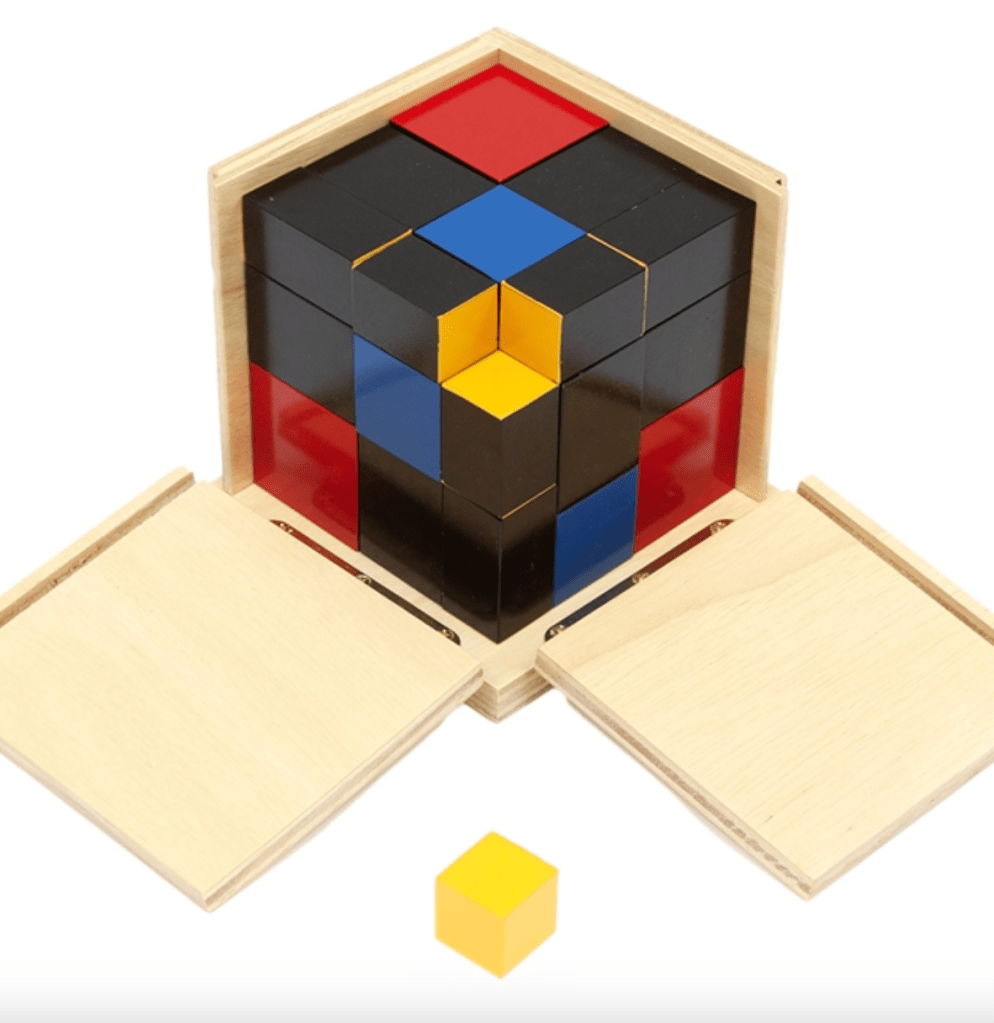
A well-designed material is ageless. When I was taking my Montessori teacher training for 3- to 6-year-olds, we were working with the Trinomial Cube in the stairwell of Victoria College in Toronto. The Trinomial Cube is a physical representation of (x + y + z)3 that is introduced sensorially to children around the age of four as a 3-dimensional puzzle solved by matching colours and shapes. In Elementary classrooms it is used to explore cubing trinomials through assigning numerical values to the variables, and then to explore cubing and finding cube roots – an introduction to algebra. A gentleman passed us going down the stairs, then paused and returned to our landing. Was this what he thought it was? A physical representation of a trinomial? This math prof immediately plopped down on the floor beside us, fascinated.

alisonsmontessori.com
Photo by P Gere

What were your favourite manipulatives as a youth? Lego, puzzles, building sets, an Easy-Bake oven, carpentry tools, games like ‘Hungry Hippo’ that you had to build first? Chances are they involved movement, possibilities, creation, action and result.

We shouldn’t confine learning to paper and pencil or to the ubiquitous screen. We limit what we and our students can achieve by doing so. Instead, here’s to exploration and learning that engages the hand as a powerful tool of the mind. Here’s to an advantage we have over AI.

Exploring the Decline of Canadian Education Quality

On June 21 CTV published What’s causing Canada’s education quality decline? Experts chime in. Aarjavee Raaj, the reporter, pointed out that Canada’s results on several international assessments have been declining since 2000. This is a short article about a major issue – education decline – but it includes a number of assumptions and suggestions that spotlight issues, and if we understand the issues can point to opportunities.

Photo by Andy Barbour on Pexels.com

First, although I agree that the quality of education in the public system in Canada is declining, test scores are only one indication. Equally, or more important, are the increase in violence in schools, the increase in teenage suicides, mental health and addiction issues, the burgeoning business of private tutoring by companies or individuals, declining numbers of those willing to enter the teaching profession, and the increase in the number of teachers whose working conditions have declined so that many leave well before retirement. To tackle one issue without looking at all the others is a ‘whack a mole’ approach with little chance of success. As John Richards, an expert on social policy and education and an author is quoted: “I don’t think there’s one silver bullet that will make Canada go back to where it was at the beginning of the century.”

“Go back to where it was …” Undoubtedly, Richards is referring to going back to the test scores and international ranking we once held but such language also subtly implies that we should go back to the way things were. There are many questions wrapped up in this innocuous statement. Are the international assessments the most important ones for determining education quality? Shouldn’t we be considering new approaches and new ways of assessing, given that we have a very different world and should have very different learning goals? Rather than return shouldn’t we focus on the present and move into the future.

Still, let’s examine the issue of quality from the perspective raised in this article – assessment by tests. One issue the article discusses is ‘summer learning loss’, suggesting that eliminating the long summer vacation may be a solution that would increase knowledge retention and test scores. Really? Summer learning loss was as much a factor in 2000 when scores were higher so it is unlikely to be the cause of the decline. Eliminating summer learning loss may be helpful to increase test scores but it will not uncover or address the underlying issue. (It would also require a major investment in infrastructure given that many public schools are not air conditioned and our summers have more heat and air quality warnings than before.)

In the article, another expert, Todd Cunningham, a clinical and school psychologist and an associate professor at the University of Toronto’s Ontario Institute for Studies in Education (OISE) also suggests that there is evidence that students can maintain their learning over a long summer break if their families have the resources available to support them in maintaining this. This reinforces reconfiguring the school year but it ignores a more significant fact. Private tutoring is the way many children manage to do well in public school these days – if their families can afford it.

Photo by Andrea Piacquadio on Pexels.com

Two of my three publicly schooled grandchildren are tutored which surprised me because both are intellectually capable of doing well. However, they weren’t thriving in school. Tutoring helped the oldest to graduate Grade 8 with honours. Finding a suitable, available tutor for the younger one has been a struggle but she now is being tutored weekly and her confidence and abilities are on the rise.

Even more surprising is that when I discussed tutoring with their parents, I found tutoring is the norm for many of their friends as well. A quick search of tutoring businesses demonstrates the pervasiveness of this trend. The current system of schooling is not serving anyone well and needs to be changed to increase the likelihood that students of parents who can’t afford tutoring have an even chance of success, that we are not widening the gap between the ‘haves’ and ‘have nots’ by the way we school.

On a brighter note, I have recently learned of two programs where test scores improved after a change in programme, changes made for reasons other than directly improving scores.

In the Yukon, several First Nations have their own school board. As Melissa Flynn, executive director of the First Nations School Board states In The Walrus article First Nations Are Rethinking Education in the Yukon and It’s Working: “Improving educational outcomes starts with embedding First Nations world views across subjects, incorporating First Nations language instruction, and inviting Elders into the classroom,” and “Instead of following a top-down hierarchy, the board’s organizational chart places students at the centre, surrounded by parents, teachers, support staff, and the broader community.” The result was reported in the Yukon News: “The board’s 2023/24 report also states that students’ standardized test results have improved by up to fourteen scores. “When Yukon First Nations learners see themselves reflected in the learning and see that their language and culture is being upheld, we find that their attendance and their satisfaction and happiness with school changes,” said Erin Pauls, the board’s director and land and language team lead.”

In Jason Buccheri’s Education Matters Podcast, Designed to Fail with Ira David Socol, Ira tells of a project he brought to a rural, Virginia middle school with socio-economic and diversity challenges. As is his modus operandi, he asked students what they wanted to change about their school. They wanted to change their cafeteria which was outdated, without natural light, dismal. With an architect for support, students decided they would build treehouses for their cafeteria. Yes treehouses, actually rolling treehouses. The entire school spent two weeks dedicated to the task and the results were what Ira described as magnificent. Now it happened that those two weeks were the weeks immediately before the big Virginia exams. This type of activity wouldn’t seem to have much to do with test scores but as Ira recounted, “For the first time in seventeen years the school passed the State Math Exam.” The students had spent two weeks immersed in math that mattered – to them. And it stuck. (This episode of the Education Matters is over two hours long but well worth the listen. You can find the rolling schoolhouses at the 2:00 hour mark.)

Generated with AI

Here is the issue Ira’s experiences raise – that of relying on ‘evidence’ to determine what to change in schooling.  Cunningham is quoted: “We’re trying to help shift the understanding and knowledge base that teachers have to be more in line with what the evidence (shows) are the best practices for literacy and numeracy.” One major concern is where does this evidence come from? Who is funding the research? Independent organizations, or individuals or companies with a stake in the outcome? (The influence of the education business on schooling requires its own research.) Then there is the fact that emphasizing evidence automatically eliminates what hasn’t yet been tried, what is possible, what could be created. Evidence also generally ignores that we aren’t educating widgets that come to us with similar characteristics. We are educating individual human beings with similarities but also the idiosyncrasies that are humanity’s strength.

This CTV article also states that “According to Cunningham, teachers are facing a different set of challenges in the classroom, and there needs to be more investment in the training and upgrading of their knowledge and skills, along with additional support.” Instead of re-educating teachers, why aren’t we investing in systems that would allow teachers to share what their experience says works and doesn’t work? Why do we believe the experts are anywhere but in the classrooms?

“I don’t think there’s one silver bullet that will make Canada go back to where it was at the beginning of the century,” he [Richards] said. Certainly, this is true. But going back to where we were, especially when looked at from the single perspective of assessed academic achievement is not a challenge worth pursuing. We must look beyond this education system that we believe is the only possibility. (We believe it’s the only possibility because it’s already here, because it’s so pervasive, and because it’s so ingrained with government and educational providers including teachers’ education.)

Today’s world is vastly different and ever changing. We desperately require an education system that can keep up, one created for these times. Individuals, organizations and schools have taken up the challenge. Join them in looking up and out at the possibilities.

The last week of school and grading gets a failing grade

Assigned work and grading detracts from life-long learning.

It’s the second last Wednesday of the school year. My Grade 8 granddaughter is musing that tomorrow is the last day her teacher will accept assignments. “What about any work we do in the last week. How does it count?” Such a pertinent question! 

“How does it count?” When schooling is about doing what you’re told to do, in the way you’re told to do it, in order to be told how well you have done, in order to get a grade, it fails even if students get ‘A’s.

Image AI generated

Learning for the sake of learning; learning how to learn and discern, being engaged, being curious. These are the attributes humans need to thrive in today’s world. A thirst to learn, discern and act. A wonderment and a belief that we have a role to play in this world of ours.

Our curriculum-centred, teacher-directed, graded schooling does not encourage these attributes; in fact, it squashes them.

Several years ago, the parent of a second grade student named Meg engaged me, the principal of an independent K – 8 school, in a quick conversation on the sidewalk after morning drop-off and before rushing onto her job.  “I thought this school didn’t assign homework.”

She was correct. Our school did not assign students homework except if a student had a special need where a small amount of repetition at home would help, such as practicing math facts for 5 minutes in the car on the way to school. We did assign parents ‘homework’. We asked parents to read daily with their children. We asked them to spend time with their children doing something together that they both enjoyed like going for a bike ride, or something that needed doing like making a meal. Driving to an activity or watching a screen didn’t count!

Why was she asking? Meg’s mom explained that the previous night she had found a book about animals, a pencil and some papers where Meg had made notes – in Meg’s bed, where she had obviously fallen asleep while working. Why hadn’t she been told that Meg had an assignment due? She and her husband would have been happy to help her complete the work. I said I’d look into it for her.

Image AI generated

Well, it turns out there was no assignment, there was no homework. Meg had become interested in marsupials and had decided to do a project. School ended for the day but Meg wasn’t done so she took the book and her notes home. Meg didn’t ask her teacher; she just assumed that her exploration, her work, could continue at home. Why not?  Meg wanted to know more and didn’t see the need of waiting for school. This was her learning. Meg believed it could take place anywhere, whenever she had time, even in bed before falling asleep.

Schooling would do a much better job of educating youth if the system supported this type of learning – student-driven, curiosity-driven, I-can’t-wait-to-find-out driven!

Superintendents, principals, teachers, and most parents expect work to be assigned and assessed. As a result, the last weeks of school are often filled with entertainment designed to keep students quiet as teachers need time to receive work, mark it, write up report cards and have those reviewed. This is a systemic problem, the system encourages completion of assignments for the sake of getting a good mark rather than encouraging learning for learning’s sake.

But how will we know how well students are doing if we don’t grade? How about keeping track of mastery? This is what we did in Meg’s school. We didn’t give grades. We did keep careful weekly records of what each student had been introduced to, was working on and had mastered. This was essential for us because our teaching was individualized even though we had classes of 25 to 30 students. It all worked because we relied on students’ natural desire to be challenged and we tailored our interactions to their interests, abilities and needs. We could say what a student could do well, what they were working on and what they were just being introduced to in any week of the year. We had no need to give them a grade to be able to discuss who they were as a learner and where they were on that journey.

Think about it. We don’t give toddlers marks for learning to walk or talk. We support each toddler where they are with encouragement, support and joint celebration of their accomplishments. We don’t compare or grade them and yet they all become accomplished walkers and talkers unless there is some disability and even then they are driven to achieve these skills in whatever way we can help make possible.

A non-graded schooling model based on students initiating their learning for inherent joy and accomplishment would lead to a much different learning culture than the one that is most common now. The last weeks of school would have as much learning value as all the other weeks of school. And, as Meg demonstrated, learning would more likely continue outside of school, in the evenings, on weekends, and even over the summer break.

Instead of learning only in and for school, youth should be groomed to learn for life. Then our education system would be much more likely to meet today’s ever changing needs. A thirst to learn, discern and act – here are some Canadian, Indigenous and international programs that are stepping into this possibility and some organizations and individuals who are encouraging it.

Student Angst: The Disconnect Between Classrooms and Student Needs  

(As I was preparing to post this article, the CBC published Jessica Wong’s article Teacher shortages persisted this school year. What’s being done to fill the gap for the next? The CBC article is broad ranging, as it should be, but clearly indicates that student angst plays a major role in teacher shortages.)

As the principal of a large preschool through Grade 8 independent school, I did not often have students brought to my office for disciplinary reasons. Our school worked diligently to meet the individual needs of our students at each stage of their development. With careful observation, freedom for teachers to choose appropriate responses, and joint problem solving, there were few disciplinary problems. But one boy, Paul, new to our school, was acting out in his preschool class of 3- to 6-year-olds. He was 4 ½ years of age but big for his age and easily mistaken for a 6-year-old. He was being aggressive towards the adults and just couldn’t settle to any activity. He was challenging and rough on the playground as well. His teacher, the other adults, his parents and I had talked about him and tried a number of different approaches and agreed that if he was having a particularly difficult time, he could be brought to my office and ‘hang out’ with me. He could work/play at a table in my office or come with me as I did my daily ‘walk-about’ the school and then return to his classroom when he was ready. This worked on several occasions but it so happened that one day, when his teacher brought him to my office, he stood just outside my door but wouldn’t come in. After some discussion with him, I finally said, “Just step in for a moment.” Well, that’s exactly what he did. He stepped over the threshold, paused and immediately stepped back outside. I had to laugh, and so did he. I stepped out and invited him to walk with me to see what we could see around the school. He came with me and eventually I dropped him back at his class.

Illustration AI generated

This was a turning point – for me! When Paul, stepped into and then immediately back out of my office, a light bulb went on. Paul was in the wrong class! By age and academically he should be with the 3- to 6-year-olds, the preschool group, but when I thought about it, he had many characteristics of an early elementary child. He was physically large for his age and well-coordinated. Outside he loved to play organized sports, not be in small, less organized groups that younger children prefer. And, as he demonstrated at my office door, he had the mindset of an elementary child with the play on words. Now his academic skills were not high and there were many things, including being able to read, that he couldn’t do as well as an elementary student but we could manage that whichever class he was in. So, after explaining this to his parents and then to Paul, ‘We think you’ll be happier in an elementary class. Would you like to give a try?” we moved him to a lower elementary class of 6- to 9-year-olds, Grades 1, 2 and 3.

And that was almost the end of Paul’s visits to me. His elementary teacher had conferred with his previous teacher and brought materials that he might need into her class and put them on the shelves for anyone to use, including Paul. Elementary children being pack animals who love to play and work together in groups, welcomed Paul into their midst.  With bigger kids to work and play with all day long, Paul was in his glory and deeply content. His new friends helped him when he needed their assistance. He worked hard to try to catch up and keep up. Now he only visited me in my office to show me a project he and his new friends wanted to share.

What happened? Paul had reached the developmental stage of an elementary child early and he needed learning and play environments that matched his advanced development even though he wasn’t academically ready. His developmental needs trumped his academic abilities and once his needs were met, his misbehaviour disappeared and he used his energies to become one of the gang in every sense, including academically.

Perhaps the most striking example of this disconnect in education today is seen with adolescents. The apathy, anger, disrespect and violence evident in high school is the tip of the iceberg. The underlying truth is that high schools do not meet young people’s needs and now more than ever that matters. Without the discipline and expected respect of previous generations, high school students are acting out, as they have done in earlier times, but with greater frequency and at a more disturbing level.

All humans are born with drives to strive, explore, move, order, learn patterns, socialize and communicate. We use these extensively as we are growing up to become an adult adapted to the times we live in. These drives are with us throughout our lives but at different periods in our development these and other drives are more prominent.

Photo by Mikhail Nilov on Pexels.com

The preschool child must move. Sitting still for any length of time is difficult if not impossible. These children are refining their motor skills. They use their senses and movement to absorb what is around them. They learn through their activity. They love to repeat things over and over. Their sense of order is very strong and they are attentive to detail, to small things. All these tendencies support their absorption of the culture surrounding them, language being an obvious example. At this stage they have literal understanding – everything they experience is real. While they enjoy the company of other children the focus is on themselves and their own increasing capabilities. This is the age of “I can do it myself.”

Around age six, about the same time as physical changes occur like losing their baby teeth, there are changes in what interests and motivates children. The elementary-aged child no longer likes to repeat – “I’ve already done that.” Details are much less important to them, but they love large things and the want to understand how everything is organized. They are able to imagine entire worlds. This is the age of dinosaurs and space, past civilizations and impressive human accomplishments. They still need to move and create. Their interest in organization also shows up in socialization – not just the groups they now always want to be with and in, but what’s fair and what isn’t and what you do about this. Elementary-aged children generally are busy refining themselves and figuring out where and how to fit in rather than changing exponentially.

Adolescence, however, is a time of great transition and uncertainty. We all remember, none of us escaped. Our bodies changing, our emotions on edge. Where do we belong? Where are we going? Who are we supposed to be – and will anyone like us when we get there? 

Photo by Photo By: Kaboompics.com on Pexels.com

Much of the adolescent angst we see in high schools is a result of, or at least magnified by, the conditions high school places on youth. Ask an adolescent about their experience in school on any particular day and the most likely response will be about some extracurricular activity – a sport , a band or a drama, art or debate club. You have to press to find out what they are doing academically because academics have little to do with what they are biologically programmed for – who they are becoming and where they fit.

Adolescents need authentic experiences that introduce them to and prepare them for the real world. They crave authentic challenges, not sitting in a classroom walled off from the world they are driven to be part of. They crave making their own decisions, testing themselves. Generally, the closest they can come in school to an authentic challenge is the extracurricular activities where they have some agency.

Adolescents also need a mentor, someone, other than a parent, who is there for them. If a high school student belongs to a team or a club, that mentor is often the coach or teacher in charge. Sometimes the mentor is a subject teacher. But every adolescent should have someone who walks beside them through high school. Not a different person every year or for each subject but a true mentor for the entirety of the high school years. Ideally, small (<15), consistent mentor groups would meet regularly, at least weekly, so that an adolescent with a concern, or who the school is concerned about, has someone who they know and trust, and someone who knows them, to turn to with the challenges that inevitably accompany adolescence.

What if high school was organized around adolescents’ natural drive for maturity and agency in the adult world? It would be an entirely different high school. What if school at each developmental level used the characteristics of that age to advantage? What might we discover about the power of youth if we used their schooling to work with and for them rather than against their very natures? Here’s a peek.

Valedictorian Censured – The Damaging Mismatch of High School Goals

The challenges of schooling in today’s world were front and centre at an Ottawa high school’s graduation ceremony. This time of year is filled with graduations, one of the few rites of passage we have in Western secular society, a time for graduates to celebrate their accomplishments and experiences, a time for schools to celebrate what they’ve been able to develop and pass on. In this high school though, the principal censured the valedictorian for her interpretation of what that experience included.

Photo by Pavel Danilyuk on Pexels.com

The valedictorian included this statement in her remarks: “As a commitment to truth and reconciliation, I must acknowledge colonial and genocidal atrocities today, including the massacre of more than 17,000 Palestinian children in Gaza.”  The valedictorian said she felt this reflected her experience in school, the lived reality of many of her fellow graduates. She felt that she had connected the situation to the values of the school board and what she had learned throughout her four years at the school.

The principal felt that her statement caused harm and was uncomfortable enough with the situation to send out an email to parents stating that the speech “intentionally took focus away from the purpose of the event, celebrating the achievement of our graduating class.”

Hopefully the principal and the student have resolved the situation in a manner helpful to everyone.

For me, this unfortunate incident represents the challenge of schooling today. When we look at education as the successful completion of courses which represent specific bits of information and academic skills, we can miss the overall purpose – that of preparing young people for the world. This is a world they already live in, in spite of our attempts to protect them. When the school’s primary purpose is to transmit knowledge or skill, it is all too easy to lose sight of this more important goal.

We live in a complex world. Youth live in this complex world for which they will soon have responsibility. It’s a lot to ask of schools, to take on this complexity. Hey, it’s a lot to ask of youth, of everyone, but do we really have a choice? Taking a more comprehensive view that includes this complexity would change the way we school. High school adolescents are developmentally ready to be engaged in life. They need supports, yes, but they learn best by doing, by working on real problems that have significance for them. We could encourage youth to explore areas of interest, areas of importance to them, areas that make a real difference in the world now, and support them to do so; then figure out how these explorations meet or could incorporate the curriculum goals. (AI anyone?) Let’s celebrate this drive and use it instead of relegating it to the shadows.

Our schooling system is outmoded and focused on too limited a scope. The movement for change has started. Here are some examples. Let’s help everyone – the students, teachers, administrators and our world by embracing this change.

The Benefits of Multi-Age Classrooms in Education

In my grandchildren’s public school, they’ve chosen to have combined Junior/Senior classes, each class having both 4- and 5-year-olds. Oh, to see this idea extended so that schools would have combined Grade 1 to 3 classes, Grade 4 to 6 classes and Grade 7 and 8 classes!

Photo by Pavel Danilyuk on Pexels.com

While children change as they develop, it is widely agreed that within these three-year age ranges, children have similar physical, emotional, social and intellectual characteristics and needs. (3-year-olds also have the characteristics of the 4- and 5-year-olds, and, in developmental terms, Junior High should encompass 12- to 14-year-olds, Grades 7, 8 and 9). We can efficiently provide for the physical, emotional, social and intellectual needs within one class even with a three-year age range, if we choose that age-range to coincide with natural human development.

Let’s put aside the challenges of covering three grades of curriculum for the moment, and look at the advantages of multi-age classrooms.

Having students in a class for three years allows for a community to develop and to be passed on each year as only a third of the class graduates and is replaced by younger students. Two-thirds of a class remains to hold its mores and rituals. No need to start fresh each year. New students learn what is acceptable through observation, participation and role modeling.

In a three-age classroom there is a wider continuum of achievement. Where you fall in comparison with your age mates is not nearly so visible. Everyone is on a continuum, improving from where they are. Students can still tell you who best to go to for assistance with spelling or math or a computer glitch, and it’s not always an older student. There is more diversity and therefore more opportunity to be valued for being who you are and for what you are achieving. There is also more opportunity to move comfortably at your own pace through the curriculum so you aren’t left behind or ‘passed’ into a grade for which you’re not ready

In this multi-grade community, the teacher is not the only one who can help or direct. More experienced students can offer assistance if you’re having trouble, and may even give instruction. Everyone has more opportunity to offer and accept help, to get better at helping, and to reap the reward of having value. The old adage that one of the best ways to learn is to teach can be used to advantage.

Photo by Vanessa Loring on Pexels.com

In a three-year class there is a continuum of community experience. You enter a new community in your first year and find your way. As a second-year, you are grounded in knowing you belong. As a third-year you are experienced and a leader but you also begin looking at the next transition. A three-year class gives students a variety of experiences in what community is, how to join one, how to maintain one, and how to welcome others in.

From the teacher’s perspective – imagine having a learning community that grows more stable each year because it doesn’t need to be created anew. As well, you know two-thirds of your students and their parents from day one and they know you. You can hit the ground running, adding weeks to the time you can devote to academic learning. You have only one-third the number of students to get to know, and more time and focus to be able to do that as the returning students are old hands who don’t need as much attention and, in fact, can assist the new ones in settling in. Having a very diverse class of abilities and needs means that you can offer students the opportunity to hone their skills and knowledge by assisting less advanced students, and provide less advanced students with one-on-one assistance all while celebrating the ability we have to be of assistance to one another.

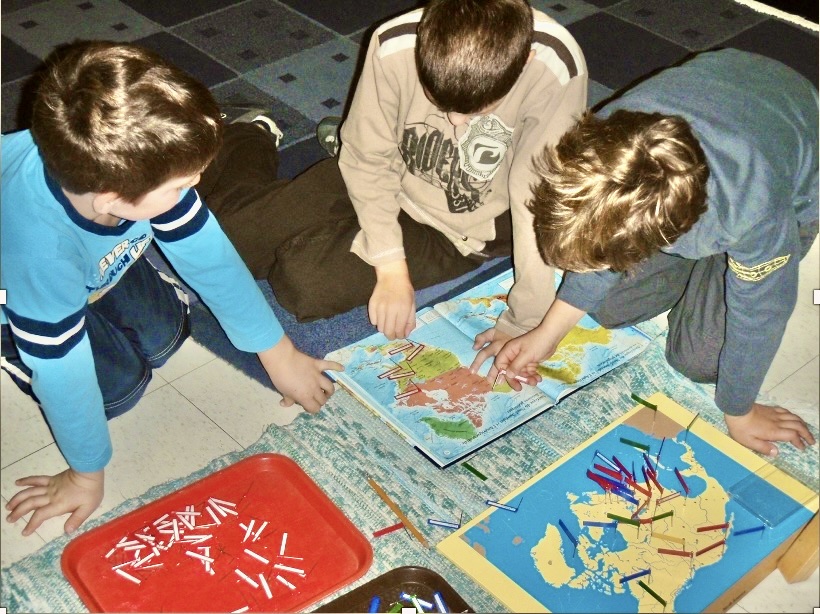
Three-grade classrooms have enormous advantages in the academic realm as well if curriculum and instruction can be managed. How though? It isn’t using a system designed for a single grade and it’s not hiding behind a screen. For younger students, concrete, hands-on materials that teach as they are used can be arrayed around the classroom for students to choose and work with independently. (Why concrete and not screen-based? So many reasons including being able to clearly observe what a student is doing, using the hands to manipulate and explore as humans have always done to learn rather than just listening and seeing, and ease of sharing with others.) For older students concrete materials become less prevalent as project-based learning and independent, self-directed studying increases. In these classes, a teacher provides instruction in how to use the material or approach the project, observes carefully as students engage, and then offers support to the students who need it when they need it.

Photo by P Gere

Some students are naturally curious and adventurous; they are easily directed and need only a little assistance. Other students may find it difficult to become engaged in an activity or need one-on-one assistance to gain confidence. The teacher is available since most of the class is working independently, and often it is helpful to both students if one helps another. In this type of class, the students become very independent. They know how the class is supposed to operate and will assist one another or a substitute teacher to make it so.

You may think this style of delivering curriculum would be a risky experiment to undertake with students whose learning will be irrevocably impacted if it isn’t successful. Fortunately, this system has been used and proven successful in high integrity Montessori education.

A word about the word – ‘Montessori’. There is no legal control over the use of the label Montessori. Anyone can call their program Montessori even if it bears no resemblance to the work of Dr. Maria Montessori. (This is one reason you may hear opposing concerns about Montessori – “Montessori is too rigid.” “Montessori doesn’t have enough structure.”) Accrediting organizations help with discernment.

High integrity Montessori programmes exist throughout the world, growing in number and influence in public systems but Montessori is not the only possibility for three-age classes. Other programs also leverage multi-year classes as do some Canadian public schools at the younger levels, as evidenced by my grandchildren’s kindergarten class.

The Killarney Public School program in Calgary has multi-grade classes as do the many Montessori public schools in the US. The Element High School in Ottawa, a non-profit but not public school, has multi-grade classes and the SparkNC programmes in North Carolina also have less emphasis of same age classes.

Mixed-age learning environments put the focus on students’ full development. Students can explore their place as valued individuals within a community while they cover curriculum: a two-for-one advantage, developing academically and socially at the same time.

Using Flow Experiences for Effective Learning

By Pat Gere

We start out as toddlers determined to master walking and talking and feeding ourselves and dressing ourselves and so much more. We end up in high school learning things as a chore, preferring to be entertained. What happened?

Humans are born with the drive to learn and adapt to their surroundings; it’s our instinctual drive to survive. Most toddlers are surrounded by examples of family and friends talking, walking, eating, and I hope, cooking, reading, playing sports and board games. What they experience and notice, they mimic. And, if we give them the opportunity, what they mimic, they repeat until they master it. Not much deters them.

Photo by P Gere

You’ll notice what I omitted – screens and our ubiquitous phones! Toddlers absorb their use as well. We teach them early who, or what, is most important. A not so tidy, perhaps not so perfect human (them and us) or the screen, the consistent entertainer and gratifier. And later we wonder why adolescents don’t engage with us, or listen to us, or value our opinion. True that was never an adolescent strong suit but now ….

Then there’s school. In spite of the best efforts of educators, school is not set up to meet the needs of youth through their developmental stages. It’s definitely not set up to support each individual’s unique personality and learning style in the way we allow toddlers to follow their internal drives. There’s the soon-to-be morning adult who rises early and accomplishes most of their work by noon versus the soon-to-be ‘I need my coffee’ individual who has their greatest productivity after lunch. There’s the introvert and the extrovert; the mover and the shaker, and the ‘Let me think about that’ ponderer, etc., etc. It’s true we need to adapt to the ‘real’ world but each forced adaptation decreases our intrinsic motivation, our joy in the effort, our joy in ourselves.

Intrinsic motivation, also known as flow – I don’t think education leadership thinks enough about this. I don’t think we adults do. This is a powerful human characteristic that not only allows humanity to adapt to its place and time but fulfills us in doing so. It’s that fulfilment the motivates us. When we are focussed and in flow we feel deep contentment and joy, and when we’re very young that keeps us seeking these experiences, naturally without any direction from the adults around us and often in spite of them. It can also keep us motivated and achieving with a strong feeling of well-being, if we incorporate it into our lives as adults.

So, let’s look at this ‘flow’. Abraham Maslow called it “peak experience;” Dr. Montessori called it “spontaneous activity;” Dr. Csikszentmihalyi called it “flow.”  Flow is a time of deep immersion, total concentration, and it’s overwhelmingly moving; a peak-like experience where you feel completely involved, have momentum, are clear and focused, where you are working at the edge of your skills. You are doing the activity for the rewards inherent in the action, not for an external reward although a reward may result. It’s something you’ve chosen to do even though it takes effort. You’ve likely experienced flow in a sport or activity you love to do; if you’re fortunate, you experience it in your work. When students are in a state of flow they are focused on their activity; do not become tired but rather are gently energized; they are unaware of the passage of time; and they experience a strong feeling of well-being. Flow comes when they choose to be engaged in an activity that is challenging but within their grasp.

To elicit flow in students requires a learning environment that allows for individual choice and provides activities that speak to the developmental characteristics of the students it serves.  These activities can and should have curriculum embedded. The activities must be available so students can make the choice that engages them in the moment. An environment that elicits flow also requires a temporal component. There must be long stretches of time when students who are engaged are not interrupted, since interruption often decreases or interrupts the state of flow.

Making a Parts of a Tree booklet – Photo by P Gere

In this type of learning environment, the adult acts as a concierge, suggesting and introducing activities to a student that are likely to create a state of flow. This means finding the activities that are just right for the student, challenging but within their reach whether in terms of physical or intellectual ability. This means introducing an activity but not insisting that it be done. This means carefully observing a student to see what engages them and when best to introduce something new and what that might be.

Now one challenge to working with flow is that it might easily be confused with being entertained, especially if a classroom uses screens; and that is another whole topic. Succinctly though, flow requires that an individual direct the experience rather than be directed by something external whether programme, game or person. Flow is gratification that takes time and effort, definitely different from most video games or scrolling TikTok. And flow results in a deep sense of well-being and quiet energy that continues even when the activity comes to an end.

Photo by Andrea Piacquadio on Pexels.com

We can create learning environments that leverage this powerful human gift of flow. High-quality Montessori programs have been based on flow or spontaneous activity for over a century. The newer, learner-centered programs are also firmly grounded in flow.

Educating our youth using flow will not only make learning more efficient and joyful but create a habit, a hankering for flow in the adults they become. Surely our lives and our world be a better place if there was more flow.

Responses

  1. patriciagarneau1954 Avatar
    patriciagarneau1954

    Does your activity have to involve a challenge in order to experiece flow?  Can you experience flow being a Montessori teacher in a classroom or does it only apply to certain kinds of activity? Pat💖Sent from my Galaxy

    Like

    1. Pat Gere Avatar

      My understanding is that challenge is necessary for flow. Any kind of activity can create flow – teaching, writing, painting, playing golf, building something.

      Like

Choosing an Education Paradigm: Curriculum-Centered or Learner-Centered?

By Pat Gere

First let me say that I’m always apprehensive when I’m looking at anything from an either-or mind set. It’s a prevalent mindset in my Western culture and can miss so many nuances – nuances that matter deeply, like the culling and then return of wolves to Yellowstone and the deep impacts each had. Life is more like an ecological system with deep, intricate patterns than it is a grocery aisle where you pick this or that. Still either-or can help us have clarity in choosing. Do we really want the cinnamon, sugar-coated ready-to-pour-and-eat cereal with ingredients we can’t pronounce or should we choose the rolled oats – simple ingredient and greater flexibility but more time intensive?

Our current educational system is built on a curriculum-centered model. This made sense when it began in North America. Youth spent most of their time at home helping their parents on a farm, in a small store or business enterprise, or at home with a big family. Schooling was a limited part of children’s lives, dedicated to reading, writing and ‘rithmetic. Strict discipline kept everyone in line.

Now youth spend less and less time with their parents and in their parents’ lives, and schooling has taken on a greater and greater role in their growth and development. But the model hasn’t changed to accommodate that. There is more curriculum – history, geography, sciences, second languages, IT, etc. There are more add-ons – values of the month and extracurricular clubs and sports but the model of curriculum centricity has not changed.

The result is the type of classroom I described in my last post – sage on the stage, do what you’re told, when you’re told; get as many ‘A’s’ as possible; a scarcity mentality where only one can be best. It is not an efficient way to learn, or to teach. It does not provide the non-intellectual skills that humans need to exist together on this planet.

There are significant, troubling outcomes of curriculum-based education in today’s world. Youth who know how to use YouTube and ChatGPT but don’t know how to care for themselves, so much so that several universities are adding courses to help youth learn basic practical life skills such as how to shop and cook for themselves, do laundry, manage finances. (‘Adulting 101′ programs help Gen Z catch up on key life skills, CBC The Current, May 24, 2025) Now this isn’t all schooling’s fault. ‘Gentle parenting’ and protection bears a part but schooling takes up more of a young person’s time and energy and being curriculum centred does not help fill in the gaps.

Also, curriculum-centered education keeps young people with their age mates for the most part, so young people spend less time than previously with different ages. There are fewer older or younger siblings and sibling friends to hang out with, less time with a new baby or toddler, fewer ‘old folks’ at home or in the community. In fact, less time in community at all. Again, not a fault of the schooling but these are experiences young people used to have but don’t have now, that a different, more flexible type of schooling might help address.

And even if a teacher in this curriculum-centered system saw and wanted to respond to young people’s needs, they rarely have been prepared by their own schooling to do so. The credentials required for teaching focus on teaching curriculum, classroom management, navigating the profession of teaching but, at least in Ontario, there is no requirement to learn about human development – the physical, intellectual, emotional and social characteristics that humans have at different stages. How can a teacher respond to the missing pieces of their students’ lives if they don’t know what they have to work with?

One growing alternative to curriculum-centered education is learner-centered programs. The curriculum still exists in learner-centered programs. These are not do whatever you want programs, but programs that take as a focus the learner and the environments that the learner is a part of – the natural world, their physical location, their community, From that focus comes a spark, an activity that engages and enlivens the learners so that they learn curriculum from their deep, innate drive to become competent humans. Since learner-centered education responds to the needs of learners and the resources available in their communities, it embodies more opportunities to respond to the complexities that make up our human life.

More and more we humans are becoming aware of our place in the world. We are part of a complex system, a complex system of complex systems. We have enormous power and if we hope to survive we must deeply understand and appreciate the complexity of the systems we impact, and we impact everything, all the time. We must also have a sense of how this power in embodied in ourselves and our fellow humans so we don’t become overwhelmed, distraught and disengage.

Climate change, wars, extinctions – we humans have created disasters with our power but we also have enormous opportunity to prepare our young to handle power and create positive change. It exists in the special human power of adaptation. Each human generation adapts to the world that exists around it, to the culture and world that exists around the infant/child as they grow, to the child rearing practices we use, and to the education system they experience. Today’s world needs an education system that takes as its basis not the curriculum to be taught but the learner and the ecosystem that that learner is to be a part of. An education system that can do more – by responding to the individual and by layering the teaching of curriculum with ways of being in the world and with one another. A system that is flexible to the times and the individual learners so that we, humanity, can maximize the gifts each individual brings to create the ecosystems that sustain us and the world of which we are an integral part.

We’ve seen changes in schooling come and go: open classrooms, phonics, whole language, rote math, new math, new curriculums. What we need is a deeper, more all-encompassing change, a change in underlying assumptions and goals, a change in paradigm away from curriculum-centered to a more responsive model. A model that capitalizes on the fact that how we educate is as important as the curriculum we teach; a model that recognizes that we learn more deeply through experience than mere instruction. We must educate our young people so they know who they are and how to care for themselves; so they value the richness of community and society; so they understand the importance of their roles as citizens, world citizens; the importance of their best selves to the future.

Take a look at some alternative models including a brief overview of Montessori education.

Just adding skim milk to our processed cereal is not going to create the change we need. It’s time for a new education, starting with the basic foundations of human development and societal needs.  It’s time for a paradigm shift and perhaps learner-centered programs are leading the way.