AI, Curriculum, and a Much Loved Children’s Encyclopedia

What young learners need in a world of AI

There’s a lot out there about AI these days. You can’t peruse any education feed or even scan a news site without running into it. I was pondering what AI can’t give us. And that led to a post on the importance of concrete, hands-on materials for younger children. The younger they are the more imperative activities that involve the hand, movement and the senses as well as the mind. Then thoughts about curriculum. What kind of curriculum do we need in this age of AI and at what age? I think most believe we still need to teach “reading, ‘riting and ‘rithmetic,” but what about all the other information based curriculum? What do learners need in order to understand history, science, the arts – the information about our world and how we got to where we are? And with that, my mind puzzlingly skipped to a longing for a dusky blue, cloth covered, heavy tome – Odham’s Encyclopedia for Children. 

Odham’s Children’s Encyclopedia

First curriculum – I, along with many others, have fallen in love with the Montessori Elementary curriculum. The first year in a Montessori Elementary class begins with the oral telling of the sweeping story of our universe and our world from the Big Bang through the formation of stars, the happenstance of our solar system, the just rightness of the conditions on Earth, the incremental changes that brought life – single cell organisms, plants, animals and finally us, humans. This story clearly illustrates how everything is connected to everything else, to the past and to what will come. The story is told dramatically, with props, activities and illustrations. There are follow-up activities that sit on the shelves of the classroom for students to use independently to further their exploration. This story is told at the beginning of every school year, Grades One through Six, developing in complexity. It provides a framework into which all other knowledge links and is given meaning.

What has that got to do with an old (and I will definitely age myself here) well-used, and loved, children’s encyclopedia. I was surprised when, as I pondered curriculum, it came to mind, especially with the emotional resonance it brought. I had moved across the province about a year ago and had carefully culled my books because books are heavy and cost a lot to move. When I thought I had left this book behind – donated it to a Goodwill store? Gave it to my son for my grandchildren to possibly use as he had? – I was bereft. It surprised me. Why did it matter that I couldn’t lay my hands on this book? I thought about what was in it and considered, for the first time, why it mattered, what it had meant to me.

First came some images – a blue line drawing of a castle spread across two pages with the keep cut away, parts labelled. Then a full colour page of flowers done in watercolour. This encyclopedia was rich with drawings and text. No photographs, mostly black and white or monochrome drawings with some full pages in colour. It was published by a British press in 1957-58. I probably received it when I was 8 and in Grade 3. I think its significance was that it was my window to the world, past and present. I was the oldest of 5, eventually 7, children in a working class, suburban family where there was always something to eat for every meal but not much extra. Neither of my parents had more than some high school; both were of British immigrant families finding their way. We didn’t travel much, certainly not outside of Ontario, or mingle with those who did. A pretty circumscribed upbringing, except for this book.
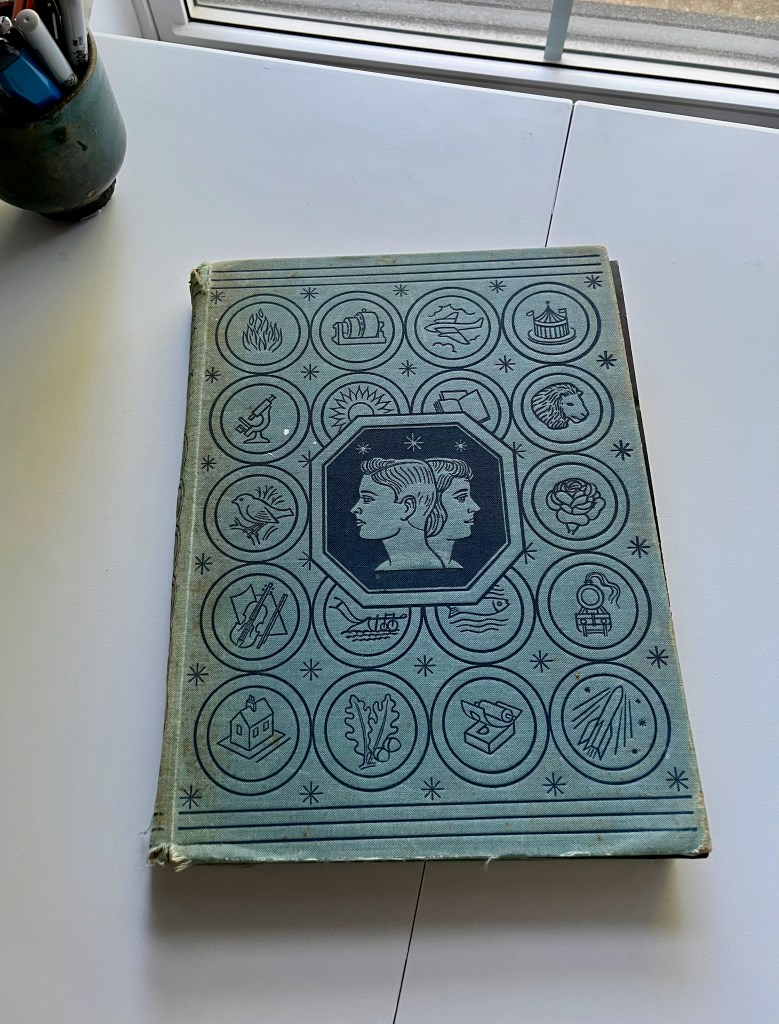
I found it tucked at the end of one of my bookcases. I had followed my heart and brought it along. In addition to delighting in the many images I had forgotten were there, particularly the continent maps with their illustrations of fauna and raw materials, and a full page of flags of the world, I took a more detailed, nuanced look, reading the editors’ notes for the first time.

This is an encyclopedia, a sort of Aladdin’s cave stuffed, not with jewels, but with facts, more marvelous than jewels and often no less precious. It is a book of knowledge – knowledge of ourselves and our history; of the universe and the world in which we live; knowledge of flowers and animals; of the things we do and use; of science and invention; of the arts; of what is familiar, and what is strange and distant.

Most encyclopedias rely mainly on words to convey knowledge. But this is an encyclopedia in which words and pictures are of almost equal importance. The result is an absorbing display. The world and its wonders become the show of shows.

Yet the display is systematic. The book does not dart from one subject to another so filling your mind with odd scraps of information but deals with each group of allied things often showing in its detailed arrangement how one thing is linked to another. So you can either read it section by section or browse in it, reading here and there as you please.

And here is the thing – I was still being pulled into the content. Even now as I write this with Odham’s beside me, I find myself first slipping through the illustrations and then stopping to read a paragraph about the Romans and soon I was reading through the Middle Ages, Dark Ages, Renaissance and into the Modern Age. The power of this book remains. Why?

It tells a story – with pictures and words. Like any great story it leads you on and in – What happened next? Why? “The world and its wonders become the show of shows.” Knowledge-wise it provides a simplified framework of linked information, enough to whet the appetite for more. It doesn’t provide all the answers. It’s like an open hill in the middle of a countryside. You can see the paths and where they lead and choose which one you want to explore. You can always come back to the hill to see where else you might want to go. A place for curiosity to begin its journey.

What led me from musing about curriculum to an old encyclopedia? Both were windows to the world, a world often beyond my experience. Both provided frameworks that organized how things were connected through time and with one another. Both provided some information – a Goldilocks approach – not too much, not too little, just the right amount. Both were always available – the encyclopedia always present physically (even now) and the curriculum available through the memories created by repetition and the availability of the follow-up activities. Both were rich in words and images, words and images that, again, didn’t tell it all but invited further exploration.

Maybe this is what children need in the age of AI – a physical book, a weighty tome, with just the right amount of information in words and images. One sitting waiting when they are ‘bored’ and they’ve run out of ‘screen time,’ or (better) haven’t been allowed any because we’ve become much more circumspect about allowing young children access to screens and AI access to our children. Maybe this is supplemented by learner-centred schooling that provides a framework approach to knowledge, a framework that opens the world and its wonders for exploration. What path will a child take from these hilltops of curiosity?

Did you have a hilltop like the encyclopedia or the curriculum? What inspired your curiosity? What helped you organize the world and its wonders? I’d love to know, especially from those of you with the view of a different generation than my own. Thanks in advance for your response.

Valedictorian Censured – The Damaging Mismatch of High School Goals

The challenges of schooling in today’s world were front and centre at an Ottawa high school’s graduation ceremony. This time of year is filled with graduations, one of the few rites of passage we have in Western secular society, a time for graduates to celebrate their accomplishments and experiences, a time for schools to celebrate what they’ve been able to develop and pass on. In this high school though, the principal censured the valedictorian for her interpretation of what that experience included.

Photo by Pavel Danilyuk on Pexels.com

The valedictorian included this statement in her remarks: “As a commitment to truth and reconciliation, I must acknowledge colonial and genocidal atrocities today, including the massacre of more than 17,000 Palestinian children in Gaza.”  The valedictorian said she felt this reflected her experience in school, the lived reality of many of her fellow graduates. She felt that she had connected the situation to the values of the school board and what she had learned throughout her four years at the school.

The principal felt that her statement caused harm and was uncomfortable enough with the situation to send out an email to parents stating that the speech “intentionally took focus away from the purpose of the event, celebrating the achievement of our graduating class.”

Hopefully the principal and the student have resolved the situation in a manner helpful to everyone.

For me, this unfortunate incident represents the challenge of schooling today. When we look at education as the successful completion of courses which represent specific bits of information and academic skills, we can miss the overall purpose – that of preparing young people for the world. This is a world they already live in, in spite of our attempts to protect them. When the school’s primary purpose is to transmit knowledge or skill, it is all too easy to lose sight of this more important goal.

We live in a complex world. Youth live in this complex world for which they will soon have responsibility. It’s a lot to ask of schools, to take on this complexity. Hey, it’s a lot to ask of youth, of everyone, but do we really have a choice? Taking a more comprehensive view that includes this complexity would change the way we school. High school adolescents are developmentally ready to be engaged in life. They need supports, yes, but they learn best by doing, by working on real problems that have significance for them. We could encourage youth to explore areas of interest, areas of importance to them, areas that make a real difference in the world now, and support them to do so; then figure out how these explorations meet or could incorporate the curriculum goals. (AI anyone?) Let’s celebrate this drive and use it instead of relegating it to the shadows.

Our schooling system is outmoded and focused on too limited a scope. The movement for change has started. Here are some examples. Let’s help everyone – the students, teachers, administrators and our world by embracing this change.

Choosing an Education Paradigm: Curriculum-Centered or Learner-Centered?

By Pat Gere

First let me say that I’m always apprehensive when I’m looking at anything from an either-or mind set. It’s a prevalent mindset in my Western culture and can miss so many nuances – nuances that matter deeply, like the culling and then return of wolves to Yellowstone and the deep impacts each had. Life is more like an ecological system with deep, intricate patterns than it is a grocery aisle where you pick this or that. Still either-or can help us have clarity in choosing. Do we really want the cinnamon, sugar-coated ready-to-pour-and-eat cereal with ingredients we can’t pronounce or should we choose the rolled oats – simple ingredient and greater flexibility but more time intensive?

Our current educational system is built on a curriculum-centered model. This made sense when it began in North America. Youth spent most of their time at home helping their parents on a farm, in a small store or business enterprise, or at home with a big family. Schooling was a limited part of children’s lives, dedicated to reading, writing and ‘rithmetic. Strict discipline kept everyone in line.

Now youth spend less and less time with their parents and in their parents’ lives, and schooling has taken on a greater and greater role in their growth and development. But the model hasn’t changed to accommodate that. There is more curriculum – history, geography, sciences, second languages, IT, etc. There are more add-ons – values of the month and extracurricular clubs and sports but the model of curriculum centricity has not changed.

The result is the type of classroom I described in my last post – sage on the stage, do what you’re told, when you’re told; get as many ‘A’s’ as possible; a scarcity mentality where only one can be best. It is not an efficient way to learn, or to teach. It does not provide the non-intellectual skills that humans need to exist together on this planet.

There are significant, troubling outcomes of curriculum-based education in today’s world. Youth who know how to use YouTube and ChatGPT but don’t know how to care for themselves, so much so that several universities are adding courses to help youth learn basic practical life skills such as how to shop and cook for themselves, do laundry, manage finances. (‘Adulting 101′ programs help Gen Z catch up on key life skills, CBC The Current, May 24, 2025) Now this isn’t all schooling’s fault. ‘Gentle parenting’ and protection bears a part but schooling takes up more of a young person’s time and energy and being curriculum centred does not help fill in the gaps.

Also, curriculum-centered education keeps young people with their age mates for the most part, so young people spend less time than previously with different ages. There are fewer older or younger siblings and sibling friends to hang out with, less time with a new baby or toddler, fewer ‘old folks’ at home or in the community. In fact, less time in community at all. Again, not a fault of the schooling but these are experiences young people used to have but don’t have now, that a different, more flexible type of schooling might help address.

And even if a teacher in this curriculum-centered system saw and wanted to respond to young people’s needs, they rarely have been prepared by their own schooling to do so. The credentials required for teaching focus on teaching curriculum, classroom management, navigating the profession of teaching but, at least in Ontario, there is no requirement to learn about human development – the physical, intellectual, emotional and social characteristics that humans have at different stages. How can a teacher respond to the missing pieces of their students’ lives if they don’t know what they have to work with?

One growing alternative to curriculum-centered education is learner-centered programs. The curriculum still exists in learner-centered programs. These are not do whatever you want programs, but programs that take as a focus the learner and the environments that the learner is a part of – the natural world, their physical location, their community, From that focus comes a spark, an activity that engages and enlivens the learners so that they learn curriculum from their deep, innate drive to become competent humans. Since learner-centered education responds to the needs of learners and the resources available in their communities, it embodies more opportunities to respond to the complexities that make up our human life.

More and more we humans are becoming aware of our place in the world. We are part of a complex system, a complex system of complex systems. We have enormous power and if we hope to survive we must deeply understand and appreciate the complexity of the systems we impact, and we impact everything, all the time. We must also have a sense of how this power in embodied in ourselves and our fellow humans so we don’t become overwhelmed, distraught and disengage.

Climate change, wars, extinctions – we humans have created disasters with our power but we also have enormous opportunity to prepare our young to handle power and create positive change. It exists in the special human power of adaptation. Each human generation adapts to the world that exists around it, to the culture and world that exists around the infant/child as they grow, to the child rearing practices we use, and to the education system they experience. Today’s world needs an education system that takes as its basis not the curriculum to be taught but the learner and the ecosystem that that learner is to be a part of. An education system that can do more – by responding to the individual and by layering the teaching of curriculum with ways of being in the world and with one another. A system that is flexible to the times and the individual learners so that we, humanity, can maximize the gifts each individual brings to create the ecosystems that sustain us and the world of which we are an integral part.

We’ve seen changes in schooling come and go: open classrooms, phonics, whole language, rote math, new math, new curriculums. What we need is a deeper, more all-encompassing change, a change in underlying assumptions and goals, a change in paradigm away from curriculum-centered to a more responsive model. A model that capitalizes on the fact that how we educate is as important as the curriculum we teach; a model that recognizes that we learn more deeply through experience than mere instruction. We must educate our young people so they know who they are and how to care for themselves; so they value the richness of community and society; so they understand the importance of their roles as citizens, world citizens; the importance of their best selves to the future.

Take a look at some alternative models including a brief overview of Montessori education.

Just adding skim milk to our processed cereal is not going to create the change we need. It’s time for a new education, starting with the basic foundations of human development and societal needs.  It’s time for a paradigm shift and perhaps learner-centered programs are leading the way.