Empowering Youth with AI: A New Educational Paradigm

I’ve been pondering Artificial Intelligence, AI, along with just about everyone else in the world and mostly coming up with negative, doomsday scenarios. But this morning, I found the nudge into a more positive place that knit together what I know from my experience schooling youth in an alternative system, my grandchildren’s recent camping trip to the wilds of Algonquin, and the article I read about an afterschool program for youth, the Youth Climate Action Leadership Series.

Photo by Laura Stanley on Pexels.com

In the age of AI what do youth need, what do they crave that would make putting effort into learning worthwhile? For some youth, the situation they’ve grown up in or that their parents grew up in clearly indicates to them that they need not onlly academic credentials but also the ‘how to’ to be successful and provide for themselves and their families. And so, they put the attention and effort into truly learning. But for many youth an academic education isn’t a priority, maybe the marks but not the actual learning They attend school because it is expected. They have to.

Developmentally, genetically, adolescents are primed for action, for risk, for learning by doing – just when we confine them to seats in a classroom and prescribe their activities. Ask most high school students about their day and the majority will tell you about anything but their classes. You’ll hear about their friends, what’s happened on social media, how well they’re doing in an online game, perhaps about football or band practice or auditions for the musical – anything and everything but their classes.

In the article about the Youth Climate Action Leadership Series in the Community Foundation of Greater Peterborough’s summer newsletter (the third article), we find one of the keys to what engaged, adolescent education could be.  In this programme youth aged 13 to 18 were invited to co-create and lead hands-on workshops on climate action.

“They’re not only working on eco-friendly craft projects while connecting with peers and community members. These young people were given real decision-making power, including how to allocate actual funds to projects that mattered to them.” And that is the key – real decision-making power – agency.

Quotes from the article show the importance and the impact:

“… the real reward was learning how to lead. Not by telling others what to do, but by collaborating.”

“Helping others boosts your sense of self… You can’t get that if you don’t go outside and pitch in.”

“[People] always say that the youth is the future, and here we are, trying to do good and help others. We just need help with it. That’s all we really need. Just more money and support so we can keep doing this.”

“By learning how to mend clothes, reduce waste, and repair electronics, these youth are doing more than gaining practical skills. They are quietly repairing something harder to measure: the frayed threads between generations, between community and climate, between the future they’re inheriting and the world they’re determined to create.”

This is what adolescent education should be.

My grandchildren’s wilderness camping trip had agency and another important component – risk. While my daughter-in-law and the children’s aunt were the responsible adults, everyone needed to work together and contribute. There was no cell service. Each day began with breakfast and group decisions about what they would do and where they would go. Meals to make and tidy up, dishes to be done, fires to be built, canoes to be paddled and portaged. And when I asked them if they were happy to be returning home – no – they would readily have stayed longer. They have camped together for a week each summer for at least 10 years and the other component that has kept them coming back is risk – opportunities to choose to test themselves. Hikes of unknown length and difficulty to spectacular views, cliff jumping into pristine waters, searching for and catching water snakes, surfing rapids, portaging a canoe. “I did it!” Just as the toddler revels in taking their first steps, youth crave testing their limits and discovering they are more than capable.

For these reasons, Montessori adolescent programs are organized around such authentic life experiences, originally, and still in some schools, specifically by residing on a farm where all its necessary, real chores and life decisions are placed as fully as possible in the adolescents’ care. The adults act as mentors, coaches and teachers. Academics are linked to the day-to-day requirements of providing for themselves and the farm.

Photo by Zen Chung on Pexels.com

Urban Montessori adolescent programs strive to provide similar experiences of adolescent ownership and responsibility with wilderness trips; work with and for urban organizations like community gardens; and micro-economies – small businesses designed, run and managed by the youth themselves that incorporate the basic concepts of production and exchange. In these urban activities, the adults must exert more self-control so as not to take on responsibilities themselves but rather set up circumstances that place the responsibility and outcomes on the adolescents – succeed or not. On a farm, everyone must work together or the consequences are very real – an animal is in discomfort or the main dinner dish is not ready on time. In urban environments it is much more challenging to place the responsibility on the adolescents, but this is key.

Adolescents are innately designed to be doing and managing and when given the responsibility they not only rise to the task but feel good about themselves and their ability to make authentic contributions.  

What does this have to do with Artificial Intelligence? What if schooling set our adolescents to work on the problems of our world? AI could track what each is learning academically as they do this and what each hasn’t yet covered. Perhaps AI could provide lessons individualized and connected to what is currently engaging them. High school buildings could become multi-age community hubs, resource-rich meeting and workspaces – those important third places that our communities are losing, and who knows, new high schools might even have a less penitentiary-like design. Teachers would be mentors, coaches and resources. Imagine having students who want to learn, who want to be involved, who choose to use AI as a tool.

I hope AI will push schooling over the edge into something more compatible with human development, and more useful, exciting, productive, and positive for youth and the world.  Given that AI can answer most assigned questions, do research, and complete fully cited essays, we have little choice but to adopt another method of education, another paradigm – a paradigm that capitalizes on the real world and its problems, and includes agency and risk in community with adults who are primed to walk with rather than lecture and direct. It is possible. Yes – it is challenging to change the direction of something as imbedded as our current schooling paradigm but maybe, with an assist and a nudge from AI, it’s possible. Let’s try and see what we’re capable of!

P.S. If you need an assist into feeling more hopeful generally, I highly recommend reading the first article in the Community Foundation of Greater Peterborough’s summer newsletter.

AI, Curriculum, and a Much Loved Children’s Encyclopedia

What young learners need in a world of AI

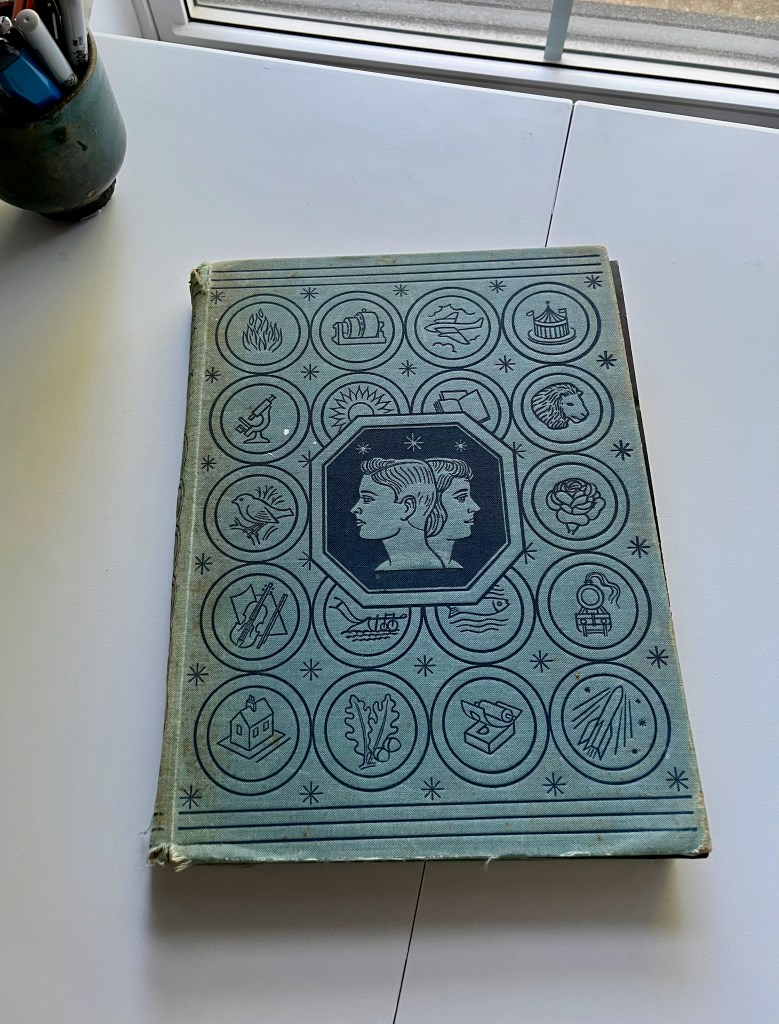
There’s a lot out there about AI these days. You can’t peruse any education feed or even scan a news site without running into it. I was pondering what AI can’t give us. And that led to a post on the importance of concrete, hands-on materials for younger children. The younger they are the more imperative activities that involve the hand, movement and the senses as well as the mind. Then thoughts about curriculum. What kind of curriculum do we need in this age of AI and at what age? I think most believe we still need to teach “reading, ‘riting and ‘rithmetic,” but what about all the other information based curriculum? What do learners need in order to understand history, science, the arts – the information about our world and how we got to where we are? And with that, my mind puzzlingly skipped to a longing for a dusky blue, cloth covered, heavy tome – Odham’s Encyclopedia for Children. 

Odham’s Children’s Encyclopedia

First curriculum – I, along with many others, have fallen in love with the Montessori Elementary curriculum. The first year in a Montessori Elementary class begins with the oral telling of the sweeping story of our universe and our world from the Big Bang through the formation of stars, the happenstance of our solar system, the just rightness of the conditions on Earth, the incremental changes that brought life – single cell organisms, plants, animals and finally us, humans. This story clearly illustrates how everything is connected to everything else, to the past and to what will come. The story is told dramatically, with props, activities and illustrations. There are follow-up activities that sit on the shelves of the classroom for students to use independently to further their exploration. This story is told at the beginning of every school year, Grades One through Six, developing in complexity. It provides a framework into which all other knowledge links and is given meaning.

What has that got to do with an old (and I will definitely age myself here) well-used, and loved, children’s encyclopedia. I was surprised when, as I pondered curriculum, it came to mind, especially with the emotional resonance it brought. I had moved across the province about a year ago and had carefully culled my books because books are heavy and cost a lot to move. When I thought I had left this book behind – donated it to a Goodwill store? Gave it to my son for my grandchildren to possibly use as he had? – I was bereft. It surprised me. Why did it matter that I couldn’t lay my hands on this book? I thought about what was in it and considered, for the first time, why it mattered, what it had meant to me.

First came some images – a blue line drawing of a castle spread across two pages with the keep cut away, parts labelled. Then a full colour page of flowers done in watercolour. This encyclopedia was rich with drawings and text. No photographs, mostly black and white or monochrome drawings with some full pages in colour. It was published by a British press in 1957-58. I probably received it when I was 8 and in Grade 3. I think its significance was that it was my window to the world, past and present. I was the oldest of 5, eventually 7, children in a working class, suburban family where there was always something to eat for every meal but not much extra. Neither of my parents had more than some high school; both were of British immigrant families finding their way. We didn’t travel much, certainly not outside of Ontario, or mingle with those who did. A pretty circumscribed upbringing, except for this book.

I found it tucked at the end of one of my bookcases. I had followed my heart and brought it along. In addition to delighting in the many images I had forgotten were there, particularly the continent maps with their illustrations of fauna and raw materials, and a full page of flags of the world, I took a more detailed, nuanced look, reading the editors’ notes for the first time.

This is an encyclopedia, a sort of Aladdin’s cave stuffed, not with jewels, but with facts, more marvelous than jewels and often no less precious. It is a book of knowledge – knowledge of ourselves and our history; of the universe and the world in which we live; knowledge of flowers and animals; of the things we do and use; of science and invention; of the arts; of what is familiar, and what is strange and distant.

Most encyclopedias rely mainly on words to convey knowledge. But this is an encyclopedia in which words and pictures are of almost equal importance. The result is an absorbing display. The world and its wonders become the show of shows.

Yet the display is systematic. The book does not dart from one subject to another so filling your mind with odd scraps of information but deals with each group of allied things often showing in its detailed arrangement how one thing is linked to another. So you can either read it section by section or browse in it, reading here and there as you please.

And here is the thing – I was still being pulled into the content. Even now as I write this with Odham’s beside me, I find myself first slipping through the illustrations and then stopping to read a paragraph about the Romans and soon I was reading through the Middle Ages, Dark Ages, Renaissance and into the Modern Age. The power of this book remains. Why?

It tells a story – with pictures and words. Like any great story it leads you on and in – What happened next? Why? “The world and its wonders become the show of shows.” Knowledge-wise it provides a simplified framework of linked information, enough to whet the appetite for more. It doesn’t provide all the answers. It’s like an open hill in the middle of a countryside. You can see the paths and where they lead and choose which one you want to explore. You can always come back to the hill to see where else you might want to go. A place for curiosity to begin its journey.

What led me from musing about curriculum to an old encyclopedia? Both were windows to the world, a world often beyond my experience. Both provided frameworks that organized how things were connected through time and with one another. Both provided some information – a Goldilocks approach – not too much, not too little, just the right amount. Both were always available – the encyclopedia always present physically (even now) and the curriculum available through the memories created by repetition and the availability of the follow-up activities. Both were rich in words and images, words and images that, again, didn’t tell it all but invited further exploration.

Maybe this is what children need in the age of AI – a physical book, a weighty tome, with just the right amount of information in words and images. One sitting waiting when they are ‘bored’ and they’ve run out of ‘screen time,’ or (better) haven’t been allowed any because we’ve become much more circumspect about allowing young children access to screens and AI access to our children. Maybe this is supplemented by learner-centred schooling that provides a framework approach to knowledge, a framework that opens the world and its wonders for exploration. What path will a child take from these hilltops of curiosity?

Did you have a hilltop like the encyclopedia or the curriculum? What inspired your curiosity? What helped you organize the world and its wonders? I’d love to know, especially from those of you with the view of a different generation than my own. Thanks in advance for your response.

Using the Hand to Optimize the Mind

Concrete materials instead of screens, worksheets or textbooks

Concrete, well-made, open-ended materials that require manipulation have so much more to offer education than textbooks, worksheets, screens or apps, especially in a world with AI. And the younger the student the more imperative their use.

Here’s an example:

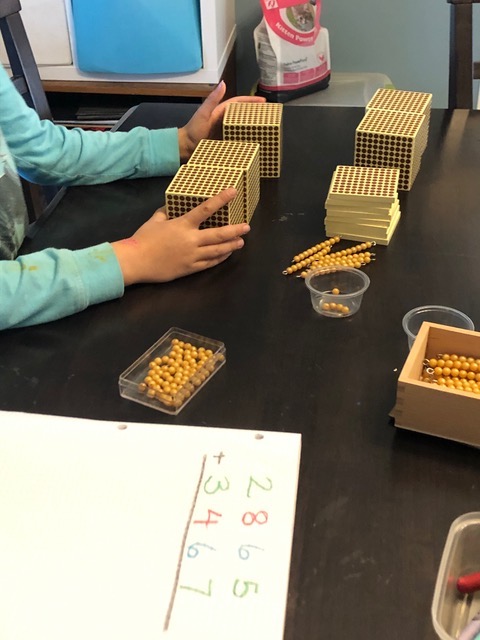
This material is called the Golden Beads. It has unit or one beads, ten bars, hundred squares and thousand cubes, and cards to go with each hierarchy. If you have an elementary-aged child, you’ve probably seen drawings of these on worksheets or in a textbook, but we should provide the material instead of the illustration. Here’s why:

Photo by P Gere

A concrete material-

  • Requires movement both large – getting the materials to a mat on the floor where you are going to work, and small – manipulating and organizing the components. (As modern humans we’re often enjoined to move more and so should our children.)
  • Combines not only the visual and auditory senses (seeing something and being told the name) but also the physical sense of dimension – how small, large, long, flat, etc.) and the baric sense (the sense of weight)
  • Provides the opportunity for working together – cooperating, negotiating, delegating, and sharing information
  • Is reusable rather than consumable
  • Is shared – requiring taking turns, as well as care and a return to its place so that others may use it (Think beyond the classroom to the reinforcement of ‘Reduce. Reuse. Recycle.’)
  • Flexible – can be used for multiple lessons – learning hierarchies and relationships, adding, subtracting, multiplying and dividing, borrowing and carrying
  • Obvious – students can see the material on a shelf and be reminded that they can work with it
  • Open-ended – students can create their own problems to work on. Young elementary students particularly enjoy ‘big’ things, the bigger the better. They can set themselves as large a problem as they want and have the immense satisfaction of solving it ‘Myself!’ At an age when repetition is not highly sought, doing huge problems provides the repetition necessary for consolidation of a concept without requiring an overseer.
  • Exploratory – “What happens if each of the three of us take out a quantity of beads without showing the others? Can we figure out who took out the largest number? How much did we take out altogether? How much did we leave on the shelf? How much does our class have when all the material is back in its place?”
  • Incremental – One concept leads to another. Learning to count and exchange categories/hierarchies to find how much you have in total before learning to add, learning to add the same addends leading to the concept of multiplication
  • Flexible – the speed with which new concepts are introduced can be easily adapted to each student as well as adapting the size or complexity of the problems tackled
  • Observable – the teacher can observe students using the material and, without interfering in any way, ascertain whether the concept has been mastered or not, and whether additional instruction is warranted – continuous assessment without tests
  • Independent – once a lesson has been given on how to use the beads for a certain task – say adding several quantities of beads together, students can work independently 
  • More likely to create flow or focused engagement – since an adult is not needed and students are having their needs for independence, movement, socializing and success met as they work, they are more likely to achieve the stage of focused engagement/flow where learning is the most efficient and effort results in renewed energy and feelings of worth and joy.

Why don’t we use concrete materials?

Why don’t we gift our students with multi-sensory, movement-required and thought-required materials that have such open-ended possibilities? It is true that successful use of materials requires a learning environment conducive to student engagement and opportunities for choice. Shouldn’t we be guiding students in making good choices as a life skill? Shouldn’t we be giving students ‘flow’ experiences so that they know the deep joy of engaged activity as an alternative to the addictive, short-lived high of being entertained, even if the entertainment is educational. Shouldn’t we be encouraging the ability to work together?

In addition to a learning environment that provides for using concrete materials, the materials have to be carefully designed in order to be optimally productive. A material should Isolate a concept but be open-ended. The only difference in these beads is how they are arranged – as single, ‘one’ or ‘unit’ beads, in a bar of ten, a square of a hundred or the cube of the thousand. There are no distractions such as cute pictures of animals, flowers or cars, only the beads. The material should be durable and beautiful and be of a size that best fits the students who will use it. Originally these beads were made of glass. Now almost all are plastic but hopefully plastic that has enough weight to give the physical sensation of the difference between the hierarchies. Practical – It isn’t practical to have hundreds and thousands made with beads, so after the concept is introduced most of the hundreds and thousands are wooden representations of the squares and cubes. The material should also be part of a continuum – before the Golden Beads a child would use a number of materials to be introduced to and consolidate the quantities and numerals 1 to 10.  After the Golden Beads the learner could use a material that represents the hierarchies with stamps that are the same size but are different colours to represent the different hierarchies, gradually moving the student from the concrete to the abstract. It’s important to see each material as related to what comes before and after, as well as to other disciplines.

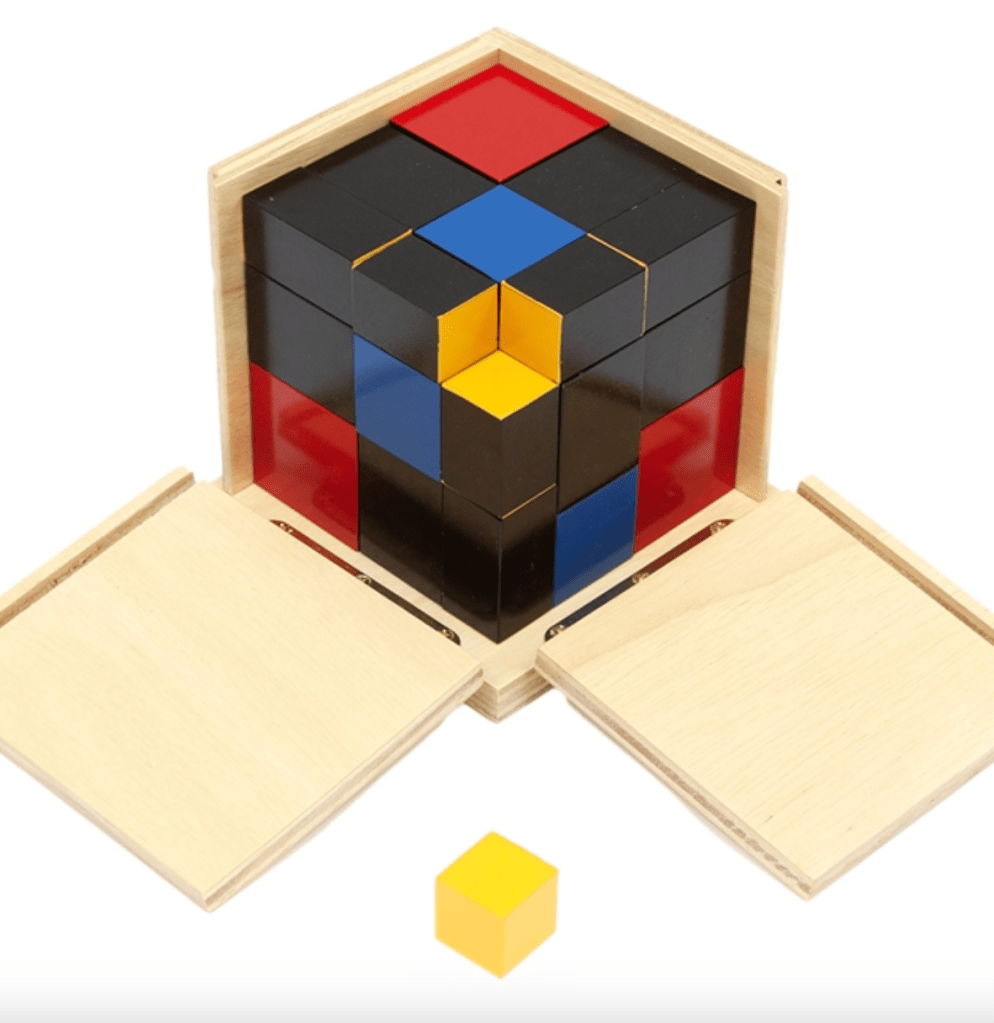
A well-designed material is ageless. When I was taking my Montessori teacher training for 3- to 6-year-olds, we were working with the Trinomial Cube in the stairwell of Victoria College in Toronto. The Trinomial Cube is a physical representation of (x + y + z)3 that is introduced sensorially to children around the age of four as a 3-dimensional puzzle solved by matching colours and shapes. In Elementary classrooms it is used to explore cubing trinomials through assigning numerical values to the variables, and then to explore cubing and finding cube roots – an introduction to algebra. A gentleman passed us going down the stairs, then paused and returned to our landing. Was this what he thought it was? A physical representation of a trinomial? This math prof immediately plopped down on the floor beside us, fascinated.

alisonsmontessori.com
Photo by P Gere

What were your favourite manipulatives as a youth? Lego, puzzles, building sets, an Easy-Bake oven, carpentry tools, games like ‘Hungry Hippo’ that you had to build first? Chances are they involved movement, possibilities, creation, action and result.

We shouldn’t confine learning to paper and pencil or to the ubiquitous screen. We limit what we and our students can achieve by doing so. Instead, here’s to exploration and learning that engages the hand as a powerful tool of the mind. Here’s to an advantage we have over AI.