In my grandchildren’s public school, they’ve chosen to have combined Junior/Senior classes, each class having both 4- and 5-year-olds. Oh, to see this idea extended so that schools would have combined Grade 1 to 3 classes, Grade 4 to 6 classes and Grade 7 and 8 classes!

While children change as they develop, it is widely agreed that within these three-year age ranges, children have similar physical, emotional, social and intellectual characteristics and needs. (3-year-olds also have the characteristics of the 4- and 5-year-olds, and, in developmental terms, Junior High should encompass 12- to 14-year-olds, Grades 7, 8 and 9). We can efficiently provide for the physical, emotional, social and intellectual needs within one class even with a three-year age range, if we choose that age-range to coincide with natural human development.
Let’s put aside the challenges of covering three grades of curriculum for the moment, and look at the advantages of multi-age classrooms.
Having students in a class for three years allows for a community to develop and to be passed on each year as only a third of the class graduates and is replaced by younger students. Two-thirds of a class remains to hold its mores and rituals. No need to start fresh each year. New students learn what is acceptable through observation, participation and role modeling.
In a three-age classroom there is a wider continuum of achievement. Where you fall in comparison with your age mates is not nearly so visible. Everyone is on a continuum, improving from where they are. Students can still tell you who best to go to for assistance with spelling or math or a computer glitch, and it’s not always an older student. There is more diversity and therefore more opportunity to be valued for being who you are and for what you are achieving. There is also more opportunity to move comfortably at your own pace through the curriculum so you aren’t left behind or ‘passed’ into a grade for which you’re not ready
In this multi-grade community, the teacher is not the only one who can help or direct. More experienced students can offer assistance if you’re having trouble, and may even give instruction. Everyone has more opportunity to offer and accept help, to get better at helping, and to reap the reward of having value. The old adage that one of the best ways to learn is to teach can be used to advantage.

In a three-year class there is a continuum of community experience. You enter a new community in your first year and find your way. As a second-year, you are grounded in knowing you belong. As a third-year you are experienced and a leader but you also begin looking at the next transition. A three-year class gives students a variety of experiences in what community is, how to join one, how to maintain one, and how to welcome others in.
From the teacher’s perspective – imagine having a learning community that grows more stable each year because it doesn’t need to be created anew. As well, you know two-thirds of your students and their parents from day one and they know you. You can hit the ground running, adding weeks to the time you can devote to academic learning. You have only one-third the number of students to get to know, and more time and focus to be able to do that as the returning students are old hands who don’t need as much attention and, in fact, can assist the new ones in settling in. Having a very diverse class of abilities and needs means that you can offer students the opportunity to hone their skills and knowledge by assisting less advanced students, and provide less advanced students with one-on-one assistance all while celebrating the ability we have to be of assistance to one another.
Three-grade classrooms have enormous advantages in the academic realm as well if curriculum and instruction can be managed. How though? It isn’t using a system designed for a single grade and it’s not hiding behind a screen. For younger students, concrete, hands-on materials that teach as they are used can be arrayed around the classroom for students to choose and work with independently. (Why concrete and not screen-based? So many reasons including being able to clearly observe what a student is doing, using the hands to manipulate and explore as humans have always done to learn rather than just listening and seeing, and ease of sharing with others.) For older students concrete materials become less prevalent as project-based learning and independent, self-directed studying increases. In these classes, a teacher provides instruction in how to use the material or approach the project, observes carefully as students engage, and then offers support to the students who need it when they need it.
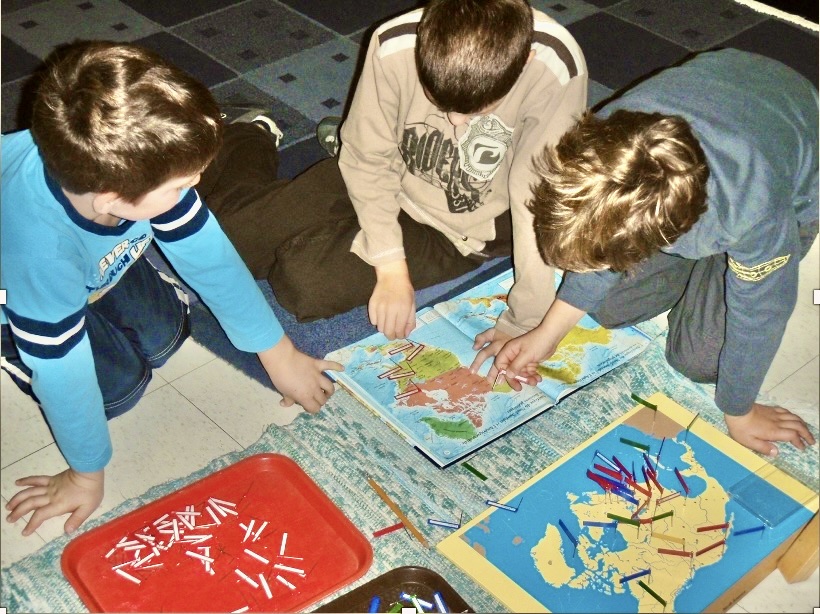
Some students are naturally curious and adventurous; they are easily directed and need only a little assistance. Other students may find it difficult to become engaged in an activity or need one-on-one assistance to gain confidence. The teacher is available since most of the class is working independently, and often it is helpful to both students if one helps another. In this type of class, the students become very independent. They know how the class is supposed to operate and will assist one another or a substitute teacher to make it so.
You may think this style of delivering curriculum would be a risky experiment to undertake with students whose learning will be irrevocably impacted if it isn’t successful. Fortunately, this system has been used and proven successful in high integrity Montessori education.
A word about the word – ‘Montessori’. There is no legal control over the use of the label Montessori. Anyone can call their program Montessori even if it bears no resemblance to the work of Dr. Maria Montessori. (This is one reason you may hear opposing concerns about Montessori – “Montessori is too rigid.” “Montessori doesn’t have enough structure.”) Accrediting organizations help with discernment.
High integrity Montessori programmes exist throughout the world, growing in number and influence in public systems but Montessori is not the only possibility for three-age classes. Other programs also leverage multi-year classes as do some Canadian public schools at the younger levels, as evidenced by my grandchildren’s kindergarten class.
The Killarney Public School program in Calgary has multi-grade classes as do the many Montessori public schools in the US. The Element High School in Ottawa, a non-profit but not public school, has multi-grade classes and the SparkNC programmes in North Carolina also have less emphasis of same age classes.
Mixed-age learning environments put the focus on students’ full development. Students can explore their place as valued individuals within a community while they cover curriculum: a two-for-one advantage, developing academically and socially at the same time.
Discover more from Convening Education Change
Subscribe to get the latest posts sent to your email.


When I was a child in public school we had combined classes. I was in a Grade 4-5 5 class and I remember listening attentively to Gr. 5 lessons. My school was also K-8 and I remember reading to Gr 1 children when I was in Gr 8 and helping Kindergarten children get dressed in winter like the studentd did in our school. How did we get from that to what we have today?Sent from my Galaxy
LikeLike
And, we had lessons on Grace and Courtesy. Now, as a volunteer, i have to tell a Gr 4 student they will not speak to me rudely and will treat me with respect. We would never have spoken to a teacher/adult like that never mind a volunteer. Grace and Courtesy would make a great topic for your blog. It’s one ofvthe central elements of avMontesdori environment/education as you know.🤗Sent from my Galaxy
LikeLike